Friday, April 21, 2017

5 Cli-Fi Books Everyone’s Reading: Nirvaan Sarkar makes a list with some great commentary as well!

5 Cli-Fi Books Everyone’s Reading

Get onto the latest reading trend – climate fiction

Nick Robins reviews "The Great Derangement: Climate Change and the Unthinkable" by Amitav Ghosh

http://www.resurgence.org/magazine/article4883-wanted-a-true-climate-fiction.html


Nick Robins reviews "The Great Derangement: Climate Change and the Unthinkable" by Amitav Ghosh

KEY QUOTE: ''Of course, this omission of climate from the world of the novel is not complete. Indeed, there are the beginnings of a new trend in climate fiction (cli-fi). '' SEE BELOW


According to Indian-American writer Amitav Ghosh, the global literary world has failed to respond to the existential threat of climate change. His starting point is clear: “the climate crisis is…a crisis of culture, and thus of the imagination.” Known for his great historical novels (notably the recent Ibis trilogy), in this book Ghosh reflects on his own craft and finds writers complicit in the continuing concealment of global warming.


This short and punchy book is made up of three loosely connected essays. The first focuses on Ghosh’s core concern of literary fiction. He then turns to another great narrative tradition, that of history, and the way in which climate change forces us to rethink our past. The final section focuses on ways to embolden our political response.


For Ghosh, the modern novel is stuck in a rut where Nature is seen as forever passive, a mere backdrop for human drama. What climate change does, he argues, is to dispel this illusion and restore a vital agency to Nature. Ghosh’s own experience in his ancestral Bengal, with its shifting rivers and floods, makes him conclude that the land “is demonstrably alive” and “is itself a protagonist”. For him, the great peculiarity of the modern age is the belief that the planet is inert. Like C.P. Snow in his earlier identification of industrial society divided into two cultures – one scientific and the other artistic – Ghosh also sees a fundamental rupture, with Nature consigned to sciences, forever off limits to the world of culture.


Of course, this omission of climate from the world of the novel is not complete. Indeed, there are the beginnings of a new trend in climate fiction (cli-fi).


Ghosh himself cites a range of English-language writers who have engaged powerfully with global warming, notably Margaret Atwood, J.G. Ballard, Barbara Kingsolver and Ian McEwan. Ballard’s 1962 novel, The Drowned World, is perhaps the most spectacular, as it set out the terrifying impact on the human mind of runaway climate change decades before the issue had hit the headlines. In Kingsolver’s deeply moving Flight Behaviour, the monarch butterfly becomes a key character in a world where “sensible seasons had come undone.”
Yet the invisibility of climate change in the vast bulk of novels speaks to two deeper and more fundamental fault lines. The first is the cultural turning in literature away from collective experience – the kind of engagement that produced works such as John Steinbeck’s Grapes of Wrath. In the 20th century, the rupture caused by the combination of brute capitalism and empire not only prompted a literary outpouring, but also stimulated efforts to reconnect literature with the world of the dispossessed. For the Bengali poet and novelist Rabindranath Tagore, this meant building from scratch an international university at Santiniketan and then seeking to drive rural reconstruction at nearby Sriniketan.
Just as problematic is the second fault line, which lies deep within our human psychology. As George Marshall and Per Espen Stoknes have argued in their insightful books on how we think about climate change, the conventional way we conceive of global warming is fundamentally at odds with what motivates us. We are driven by things that are urgent and close by, but climate change is continually presented as distant in time and space. Add to this the wilful mischief of the climate deniers, the obscure language of climate science and a visual framing in terms of telegenic polar bears, and it is perhaps no surprise that novelists have stayed silent.
In light of all this, a question that Ghosh does not ask but that now seems pressing is, what would it take to produce climate literature with the equivalent cultural impact of earlier classics? Who will write the novel that encapsulates the generational breaking of climate change similar to Ivan Turgenev’s Fathers and Sons in 19th-century Russia? Likewise, what will inspire the invention of a polemical morality tale about climate change as universal as George Orwell’s Animal Farm? We can easily imagine a tale of heroic struggle against fossil fuel infrastructure as passionate as Ernest Hemingway’s A Farewell to Arms. (‘A Farewell to Fossils’, perhaps?) But it has yet to be written. Equally, we still lack a compassionate account of the loss felt by coal communities as their industry collapses, which could historically bookend Emile Zola’s great novel of coal mining, Germinal.
The place where we should perhaps look for this literature is in Asia. Ranging beyond the narrow world of the novel, Ghosh uses the essays on history and politics to trace the centrality of Asia to the climate crisis. Here the shadow of empire looms large. Of course, it was the nations of Europe and North America that first used coal and then oil on an industrial scale, in the process building up an ‘ecological debt’ to the rest of humanity. But it was in China that coal was first used widely, and in Burma that oil first became commercialised, creating the foundations for one of the world’s largest multinationals, Burmah-Shell. What prevented these first forays from flourishing, according to Ghosh, was imperial exploitation.
This delayed the great acceleration in Asia’s emissions, which not only is now creating an “airpocalypse” across the cities of China and India, but also has become the major driver of global carbon emissions. In addition, Ghosh’s Bengali heritage makes him particularly alert to Asia’s acute vulnerability to climate shocks. Nearly half the world’s people depend on the Himalayas for water – a source that is now threatened by the melting of its glaciers. The partial inundation of just one island in Bangladesh has led to the displacement of more than half a million people.
For Asia, this creates a painful lesson. Just as its populations embark on the path of resource-intensive industrialisation, they learn that “the patterns of life that modernity engenders can only be practised by a small minority.” More than this, the prevailing logic of unfettered market freedom is wholly unsuited to solving this crisis. As Ghosh writes, “at exactly the time when it has become clear that global warming is in every sense a collective predicament, humanity finds itself in the thrall of a dominant culture in which the idea of the collective has been exiled from politics, economics and literature alike.”
This conundrum creates the need for a fresh ethical strategy, not just for the likes of China and India, but for the world as a whole. Here, Ghosh turns to religion as a source of inspiration. He praises Pope Francis’s Laudato si for the way in which it draws on a faith tradition that far predates the carbon economy to first challenge the idea of infinite growth and then insist that “a true ecological approach always becomes a social approach.”
The Great Derangement is clearly not Ghosh’s final word on the clash of climate and culture. By urging us to hear both the cry of the Earth and the cry of the poor, he points the way to a resurgent literature that builds a new kinship with the rest of creation. In this way, we can begin what a character in The Drowned World foretold: the “careful preparation for a radically new environment, with its own internal landscape and logic, where old categories of thought would merely be an encumbrance”.
Nick Robins is co-director of the United Nations Environment Programme’s inquiry into the design of a sustainable financial system, author of The Corporation that Changed the World: How the East India Company Shaped the Modern Multinational, and a Resurgence Trustee.

Meet Harvey Paris in Connecticut: Working with Wood to Carve Smiles Nationwide


Meet Harvey Paris in Connecticut: Working with Wood to Carve Smiles Nationwide

Harvey


Harvey Paris, social worker, wood carver, mensch!

by Danny Bloom, internet reporter

BRIDGEPORT, CONNECTICUT -- Harvey Paris is a Jewish chip-carver who hjas carved out a place where he can put his hobby to good use.


It all started in 2006 when Paris decided to find a suitable hobby to keep him busy and quiet at home while his wife began studying for the rabbinate at Academy for Jewish Religion. The Brideport, Connecticut couple  

serve as president and vice president, respectively, of Jewish Family Service there.


“We realized that I’d have 20 hours of downtime a week while Barbara did her homework,” Paris recalls.  reporter. “But it had to be a quiet hobby.”


And quiet it was. And still is.


Meet the man who turns wood into a communication tool, using chip-carving because of its simplicity and beauty.


Chip-carving requires a hand-held knife, and you can do it while sitting on a chair in the bedroom, Paris told this reporter in a recent email interview across the seas, from my home office in Taiwan to his study in Connecticut.


A Tzedakah box, carved by Harvey Paris


​


''I am 65 years old and have spend my entire working career as a social worker and director of  Jewish Family Service agencies," Paris told me by email after I contacted him about doing a story on him. " I received an MSW from Temple University, originally planning on attending the Deconstructionist Rabbinical College in Philadelphia, but ended up in Jewish Communal Services as a social worker instead. Prior to my MSW, I created my own BA in Judaic Studies from Harpur College, which later became SUNY Binghamton and is now called Binghamton University.''

Born in 1951, Paris (more on this very interesting surname later) grew up in Brighton Beach in Brooklyn.

When asked how he got into this hobby, Paris said he had I always attracted to wood and knives, but never did more than whittle a branch or two as a kid.

"To make a long story short, my artistic career as an adult began when my wife Barbara enrolled in Rabbinic School at the Academy of Jewish Religion some ten years ago or so," he said. "My wife and I worked together (at JFS) and  lived together and generally spent all of our time together. It soon became clear that she needed approximately 20 hours per week of quiet time to 'study Torah' and I needed a hobby that I could do in a spare bedroom(our adult son was already out of the house). I wanted to play the bongo drums, but she ruled out anything noisy."


A sample of his exquisite work -- a hobby and more than a hobby!

''My first thought was Murano glass, since we had recently traveled to Italy, but the thought of molten glass in our bedroom ultimately decided me against glass. I then started reading about wood and settled on chip carving since it only required one hand held knife. I found out about Wayne Barton, North America’s premier chip carver,  referenced in books I read and enrolled in a weekend class with him in 2006. At the conclusion of the class, he did something I never saw him do since, and I have studied with him for the last 11 years. He said something like “by the power vested in me, I now declare you an artist”. I embraced those words and have lived seeing life like an artist since then.''

Paris not only is a seasoned wood carver now, he also has a good sense of humor, noting: ''My wife sometimes half-jokingly says that maybe the only reason she became a rabbi was for me to become a carver. She was ordained in April 2017."

"I consider myself the world’s premier Jewish chip carver because I think I am the world’s only Jewish chip carver," he says, again with the humor. "Chip carving takes its name from  its process of removing chips of wood from the surface with a knife. I have applied the same technique to leather as well.'

''I decided to utilize my chip carving skills towards creating and beautifying Jewish ritual objects," Paris says.  "All of my designs are my own. My first creations were etrog boxes,  tzaddakah boxes  and mizrachs. I have since designed mezuzahs, challah boards and Seder plates. "
 
''At some point I realized that I could create works of art utilizing Jewish motifs and carved my  “Peace and Promise” series, in  where I carved Peace in 7 languages including Hebrew, Arabic and Yiddish, each with one of the Biblical seven species of vegetation as the background design. I then carved a Remembrance series involving 6 pieces reflecting on traditional Jewish values such as Torah and the 10 Commandments but also remembering  the Holocaust as well as family members. ''
 
''After I received my first commission to carve an aron and bimah for Wake Forrest University Hillel, I realized that even though I am only using 1 hand held knife, I could still carve big. During the last few years I have carved larger pieces (2’ x 2’) with subjects such as King Solomon, Revelation at Mount Sinai and my latest piece in 2017, I/aiah Had a Dream, a reference to the Prophet Isaiah and Martin Luther King, a piece concerned about race and religious relations in both Israel and America.''
 
''In 2015 I became interested in installation art and began searching for an appropriate medium that I could still utilize my carving skills on. I found wax tanned leather and have since created a 5’ X 7’ carved leather scroll highlighting the Moses at the Burning Bush Story. I have plans to double the size of the carved scroll to include Moses floating down the Nile and the Plagues.''
 
Customers? Does Harvey Paris have customers and is there a waiting list?

 
"To date, most of my customers are people who have wanted presents for special occasions -- either a customized wedding plate or a Jewish ritual object that could also be customized. I have also carved 3 arons for shuls and schools.   I am hoping that people will soon start viewing my carvings in both wood and leather as art as well as ritual or celebratory.''

Paris says that he has not attended trade shows, but to get the word out about his work, he does have a dedicated website and recently started tweeting.

His website(www.jewishcarving.com) has links to a radio interview he did as well as to newspaper and magazine articles about his work.

When asked about his knowledge of the Hebrew characters he uses in his carvings, Paris had a ready answer at hand.

"I studied some Hebrew in college at Harpur, and also at Gratz College in Philadelphia as well as in Israel for a semester," he said. "I don’t speak it well or read it well, but can carve in it very nicely. Carving, like writing, is all about lines."  

Now about that family name: Paris?

"Paris is our real family name, but it was obviously changed when my grandparents came through the immigration desk at Ellis Island long ago," he said. "It might have been Poiris. No one is certain."
 
One thing is certain in 2017: Harver Paris carves wood with aplomb and pizzaz and his work is bringing smile to customers nationwide.


Thursday, April 20, 2017

An OpEd on the roots of the rising cli-fi'' literary genre in the radical Jewish magazine TIKKUN


An OpEd on the roots of ''cli-fi'' literary genre in Jewish magazine #TIKKUN

http://www.tikkun.org/tikkundaily/2017/05/09/a-cli-fi-missionary-with-jewish-roots-who-is-fighting-global-warming/


Cli-Fi @ 2y: ''Learning Geoscience through Climate-Change Fiction''

Cli-Fi @ 2y: Learning Geoscience through Climate-Change Fiction

by Professors Steve Winters and Elizabeth Trobaugh

Holyoke Community College, MASSACUSETTS, USA

Responding to the challenges of teaching geoscience in the liberal arts setting, we have developed an interdisciplinary course that fulfills both lab science and English graduation requirements. At Holyoke (Massachusetts USA) Community College, we team-teach a course called “Cli-Fi: Stories and Science of the Coming Climate Apocalypse.”

 “Cli-fi” refers to climate-change fiction, a now-popular subgenre of science fiction. Our course combines introductory literature and composition with first-year physical geology (including laboratory and field exercises).

With interdisciplinary/thematic content and a seminar-style learning environment, our course attracts a variety of students -- science majors, English majors, environmentalists, science fiction fans, etc.

We read Paolo Bacigalupi’s cli-fi novel The Windup Girl and shorter works from recently published anthologies. Standard college-level geology texts and excerpts from science magazines and journals complement our literary readings. To help students focus on climate change issues and themes, we use a “climate-change stress index” that we have developed to tabulate and categorize climate change impacts.

For each story we read, students locate and describe several features of the climate-changed world, such as adaptation/mitigation, breakdown in civilization/social order, climate imbalance/disorder, extinction, illness/disease, and resource scarcity. For the final project, students write their own original cli-fi stories using the storytelling techniques and the climate change science they have learned and researched.

Our students present their projects at an end-of-semester cli-fi/science mini-conference on campus.

Learning in Communities at Holyoke Community College

Holyoke Community College (HCC) has a well-established history of interdisciplinary learning. For over 30 years, our college has supported and promoted learning communities, courses that integrate two disciplines united by a shared theme. Two professors from different divisions combine their curricula and join in one classroom to deliver a course that invites students to actively participate in a community of learning where the professors, too, are learning each other’s disciplines alongside the students. Our course fulfills three graduation requirements for the largest degree program HCC offers, the Liberal Arts and Sciences Associates Degree: college composition II, a lab science, and integrative learning. While also teaching the principles of good writing, research, and using supporting evidence, our course provides students with a first-year geology curriculum, including labs and field exercises. Labs and field trips offer particularly rich climate-science learning opportunities: trips to a local natural history museum and dinosaur trackways to study species extinctions face-to-face; visits to a local community garden to assist rain-garden installation and other green-infrastructures to conserve and enhance our threatened water supplies.

What is Cli-Fi?

''Cli-fi'' is a term coined by climate change blogger and activist Dan Bloom to describe an emergent sub-genre of science fiction. Modelled after the assonance of sci-fi, cli-fi refers to a body of literary fiction that is responding to anthropogenic global climate change.

As cli-fi novelist Claire Vaye Watkins says, cli-fi brings the imagination to the problem-solving equation.

We use literature to ignite students’ sense of wonder and curiosity. Some believe that literature, in fact, can play a role in galvanizing people’s attention and interest in the changes occurring across the globe.

Some even believe that climate-change fiction – i.e., “cli-fi” – can motivate people to take action to protect the planet.

For example, articles in The Atlantic, The New York Times and the Natural Resources Defense Council magazine On Earth have all recently suggested that cli-fi is capturing a growing awareness and concern about environmental degradation, and these works of fiction and imagination are pushing people to care.

Some popular cli-fi novels include The Year of the Flood (Margaret Atwood); Science in the Capital Trilogy and (just out) New York 2140 (Kim Stanley Robinson); The Windup Girl and The Water Knife (Paolo Bacigalupi). Some of the best cli-fi storytelling takes the form of short fiction. Some anthologies we've used are I’m With the Bears (edited by Mark Martin, Verso); Drowned Worlds (edited by Jonathan Strahan, Solaris); and Loosed Upon the World (edited by John Joseph Adams, Saga).

It All Begins with a Story …
and the Climate-Change Stress Index

For our course, we have developed a tool we call the Climate-Change Stress Index (CCSI) to help students identify the evidence of climate-change impacts in the fictional setting of each story. This stress-index technique helps us use cli-fi’s settings, plots, and characters not just as jumping off points for general discussion but as windows through which students get an integrated view of science and fiction in one lesson.

For example, when reading The Windup Girl, students notice that resource scarcity, specifically the scarcity of fossil fuels, not only propels the plot but also leads to technological regression: in the world Bacigalupi has created, machines run on animal and human power, rather than on electricity or fossil fuel.

This adaptation has the benefit of reducing carbon emissions in a runaway greenhouse atmosphere, but it also places a premium on
calories in a climate-changed world of extinctions and agricultural plagues. Identifying real climate science in a literary text motivates students to take the projected outcomes of climate change fiction seriously and to engage critical thinking and research skills to assess a story’s verisimilitude.

The CCSI marks the beginning of the students’ critical analysis of the climate fiction and acts as a window through which students can get an integrated and in-depth view of fiction and science in one lesson.

The CCSI lists nine climate-change impacts on society and on the natural world:


❏ Adaptation/mitigation
❏ Breakdown in infrastructure
❏ Breakdown in civilization/social order
❏ Climate imbalance/disorder
❏ Ecosystem imbalance – flora and fauna
❏ Illness/disease
❏ Positive/negative feedbacks
❏ Regression (psychosocial, biological, technological, etc.)
❏ Resource scarcity

For example, with student contributions, the CCSI for Robert Silverberg’s “Hot Sky” (from Loosed), looks like the example on pages 12 and 13.

Science-story Intersects

Once CCSI impacts have been tabulated, students are ready to dig deeper into the text using a technique we call story-science intersections: a series of probing and/or leading science questions that critically explore the science that underlies the narrative. Intersects also provide a model for the final cli-fi science project.

Intersects are essentially fact-finding/fact-checking activities that ask believability questions:

▪ What is the science, if any, that underlies the fiction?
▪ Is the science used in a believable way?
▪ Does the story seem plausible?
▪ Does the story have verisimilitude?

For example, following a reading of Paolo Bacigalupi’s story “The People of Sand and Slag,” (http://windupstories.com/books/pump-six-and-other-stories/people-of-sand-and-slag/), we ask students to dig deeper into the following story excerpts:

Excerpt from “The People of Sand and Slag”

We ate sand for dinner. Outside the security bunker, the mining robots tumbled back and forth, ripping deeper into the earth, turning it into a mush of tailings and acid rock that they left in exposed ponds when they hit the water table, or piled into thousand-foot mountains of waste soil. It was comforting to hear those machines cruising back and forth all day. Just you and the bots and the profits, and if nothing got bombed while you were on duty, there was always a nice bonus.
After dinner we sat around and sharpened Lisa’s skin, implanting blades along her limbs so that she was a like a razor in all directions . . .
Lisa laughed and took a spoonful of tailings. “We can eat anything. We’re the top of the food chain.”
“Weird how it [the dog] can’t eat us.”
“You’ve probably got more mercury and lead running through your blood than any pre-weeviltech animal ever could have had.”
“That’s bad?”
“Used to be poison.”
“Weird.”
Intersects from “The People of Sand and Slag”:
Text: “We ate sand for dinner.”
Example questions:
▪ How is it possible any living thing could “eat” sand or rock? Have you heard of lichens?
Text: “Outside the security bunker, the mining robots tumbled back and forth, ripping deeper into the earth, turning it into a mush of tailings and acid rock that they left in exposed ponds when they hit the water table or piled into thousand-foot mountains of waste soil. ”


Example questions:
▪ Where does the acid come from?
▪ Can you describe the geochemistry of the tailings ponds?
▪ How would you describe the “waste soil”? Is it a soil at all? How is the presence of acid related to absence of normal vegetation?
▪ How are the soils of “The People of Sand
and Slag” similar to the soils on the Moon? On Mars?
Intersects from “The People of Sand and Slag”:
Text: “We can eat anything. We’re the top of the food chain.”

Example question:
▪ But if you can eat anything, aren’t you on the bottom of the food chain?
Text: “You’ve probably got more mercury and lead running through your blood than any pre-weeviltech animal ever could have had.”
“That’s bad?”
“Used to be poison.”
“Weird.”

Example questions:
▪ What’s “weeviltech”? (A central concept in Bacigalupi’s imagined world. We generally define it as genetically modified organisms or cellular organelles designed to catalyze and metabolize inorganic, otherwise poisonous foodstuffs such as native metals and minerals.)
▪ What other (real!) organisms may also have adapted weeviltech-like metabolisms?
▪ In what way do extremophiles have their own version of weeviltech?
▪ Where on Earth today or in the geologic past have we seen organisms that possess a kind of weeviltech referred to in “The People of Sand and Slag”?

The Cli-fi Final Short-Story Project and End-of-Semester Celebration

“An imaginary garden with real toads in it.”
– Marianne Moore
“Cli-fi is where art meets science, where data meets emotions, and where science meets art, too.” – Dan Bloom

As the culmination of the semester, we ask students to write their own cli-fi short stories. We encourage them to explore any of the ideas, themes, settings, climate/Earth science concepts that have come up in class or that they’ve generated in their imagination. While climate change often brings visions of dystopian settings and situations, we have also read stories that offer more hopeful visions of problem-solving and adaptation. In their stories, we want students to explore how humans might adapt to a new environment, a new reality. On the final day of the semester, we celebrate each student’s final cli-fi science project and short story with a reception, including refreshments and invited guests (faculty, former cli-fi students, and administrators). Our students never fail to amaze us with the stories they create out of science and imagination.

Summary/conclusion

We are fortunate at HCC to have a tradition of innovative, interdisciplinary learning that has allowed us to develop a rich climate-science curriculum centered on the popular literary sub-genre of cli-fi. It is our belief that the best science and technology are always creative, and cli-fi helps add the imagination to the geoscientist's toolkit.

Our curriculum combines the techniques of critical thinking and textual analysis from the sciences and the humanities. The fictional settings and scenarios of cli-fi expand the imagination and show geoscience principles in a fictional context, inviting students to confront the role of humanity in a climate-changed world and perhaps inspiring students to learn more about how humanity might cultivate a more cooperative relationship with the Earth.

Works Cited

Adams, Joseph, editor. Loosed Upon the World: the Saga Anthology of Climate Fiction. Saga Press, 2015.
Bacigalupi, Paolo. “The People of Sand and Slag.” Windupstories, 15 Apr. 2017, windupstories.com/books/pump-six-and-other-stories/people-of-sand-and-slag/.
Bacigalupi, Paolo. The Windup Girl. Night Shade Books, 2015.
Martin, Mark, editor. I’m With the Bears: Short Stories from a Damaged Planet. Verso, 2011.
Silverberg, Robert. “Hot Sky.” Loosed Upon the World: the Saga Anthology of Climate Fiction, edited by Joseph Adams, Saga Press, 2015, pp. 203-228.
Strahan, Jonathan, editor. Drowned Worlds: Tales from the Anthropocene and Beyond. Solaris, 2016.

Saturday, April 15, 2017

Climate-change in these 3 novels is even more terrifying than in real life: Rajat Chaudhuri explains

Climate-change in these 3 novels is even more terrifying than in real life

Fiction-writers can do a better job of convincing us that cataclysms are coming, writes Rajat Chaudhuri in India     

“Out at sea, beyond the grey stone bulwarks of the port, zigzags of lightning electrocuted the water, bringing poltergeist winds that sucked random objects up to whirl and dump. Passionate gusts punched at the sails of struggling boats and then headed inland, flattening corn, uprooting trees, smashing hop silos and storage barns, whisking up torn rubbish sacks that pirouetted in the sky like the ghostly spirits of retail folly.”
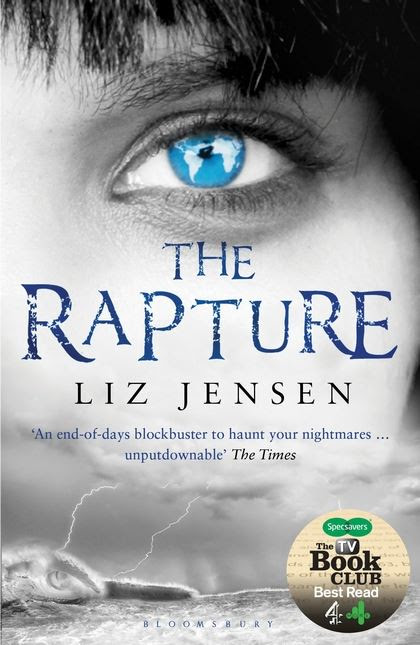
This is how Liz Jensen draws us into the world of paraplegic therapist Gabrielle Fox and psychotic teenage patient Bethany Krall in her eco-apocalyptic climate change novel, The Rapture.
What imaginative powers does it take to write plausibly about the unthinkable? Does it require a sorcerer’s occult energies, to translate the looming threats of climate change into prose that will grip the reader’s imagination, leaving her a changed person perhaps? Beyond the internal cinema and the soft afterglow that quality fiction offers, isn’t a revision in the way we observe and engage with the world also a desirable quality of a good book?
Confined for years on a regulation diet of what has been labeled “literary fiction”, I have lately been sampling a smorgasbord of eco-dystopian and, more specifically, climate fiction (cli-fi) works. Besides helping to sharpen my perspective about man-made threats to the planet, these readings have also provided pleasant satisfaction.
The books I am talking about also made me aware that the genius of their authors lies in a combination of vivid imagination, a willingness to bridge the nature/culture divide and an eagerness to experiment for the sake of telling the most urgent stories of our times. In creating these works, they have not flinched from employing specialised vocabulary or language.
Language, in fact, that is marked by edginess and novelty in one author, preparing us for the “prodigious happenings” of a book, darkly humorous and peppered with scientific jargon in another, brooding and melancholic in a third. These techniques, between them, have helped to impart characteristic flavours – a blend of urgency, despondency, vulnerability, pessimism and even a cold-hearted cynicism that suits cli-fi.
Here is Ian McEwan in Solar writing about his flawed Nobel Laureate character Michael Beard, whose patents on artificial photosynthesis could provide a source of clean energy and hence tackle climate change. The scientific vocabulary pours out at ease, mingling effortlessly in an acid bath of satire. The cynical Beard is attracted to an immigration officer at Heathrow and fantasises her working with him:
“…working with and for him, living for and with him and his vision of a world cleansed and cooled and energised by photovoltaics, by concentrated solar power, above all by his own artificial photosynthesis, and by systems centralised or distributed and grid-tied. He would teach her all he knew about thin film, heliostats, feed-in tariffs. She would be efficient in hours; out of them, generous, athletic, with low tastes.”
“What is it about climate change that the mention of it should lead to banishment from the preserves of serious fiction?” asks Amitav Ghosh near the beginning of his semi-scholarly work on the subject, The Great Derangement: Climate Change and the Unthinkable. This is an important question for me, not just because I have been a climate activist telling industry to mend its ways, but also because I had been writing a novel about environmental disaster where global warming has a role to play.
It is strange that no one has asked this question before, for surely there is no good reason that literature, whose business, as Ghosh rightly points out, is the “imagining of possibilities”, should shy away from engaging with the greatest challenge that life on earth faces today.
Barbara Kingsolver’s Flight Behavior, another book which takes climate change head-on, has a plot revolving around climate induced disruption of the migration patters of the monarch butterfly. This fascinating description of roosting monarchs overwintering in the Appalachia is from Kingsolver’s book:
“The density of butterflies in the air now gave her a sense of being underwater, plunged into a deep pond among bright fishes. They filled the sky. Out across the valley, the air itself glowed golden. Every tree on the far mountainside was covered with trembling flame, and that, of course, was butterflies.”   
Let us dig a little deeper into three novels.

Solar, Ian McEwan

McEwan’s Solar is the story of the Nobel-winning physicist Michael Beard, whose best days are behind him. A dazzling work of satire, this novel uses the character of the cynical, philandering professor to show how runaway ambition can ruin the best laid plans for a better world – in this case a world running on clean energy, freed of greenhouse gas emissions and the climate demon.
But inner demons refuse to quit as the celebrated discoverer of the Beard-Einstein conflation meanders in and out of affairs and marriages while getting assigned to head the National Centre for Renewable Energy in Reading. There is a storm brewing in his personal life because his fifth wife Patrice has started an affair with an obnoxious builder named Tarpin, but Beard still loves her.
At the Centre, Beard meets the brilliant researcher Tom Aldous, whose gangling, big-boned features and a mind bristling with ideas has more than passing resemblance with the polymath novelist and acclaimed master of dystopia, Aldous Huxley. It is interesting to remember here that the novelist Huxley, in his Science and Literature, was one of those who had engaged with CP Snow’s Two Cultures and the Scientific Revolution and had himself written a memorable novel that blurs the science/literature or nature/culture divide.
McEwan’s Aldous has path-breaking ideas for clean energy, including the quadruple-helix wind turbine, which the Centre takes up, but his other passion soon brings him in direct conflict with Beard, leading to disastrous consequences, and a train of incidents that keep the plot on the boil.
Meanwhile the professor and a group of climate-conscious artists are taken on a junket to the Arctic to watch global warming in action for themselves on the island of Spitsbergen, where, “just ten miles away, was a dramatically retreating glacier whose sheer blue cliffs regularly calved mansion-sized blocks of ice onto the shore of the fjord.”
In a characteristic satire-laced tone that helps expose the shadow-boxing and inherent cynicism of a consumer culture, the author slips in an aside about the carbon offset for the trip – how the “guilty discharge of carbon dioxide from twenty return flights and snowmobile rides and sixty hot meals a day served in polar conditions would be offset by planting three thousand trees in Venezuela as soon as a site could be identified and local officials bribed.”
The Arctic trip has its own darkly humorous interludes, including one where Beard almost loses his penis to frostbite and a funny and allegorical boot room story, which seems to be a comment on how human beings have destroyed the environment by not following rules.
On his return from the Arctic, Beard gets sucked into a vortex of events from which only vengefulness and cunning can save his skin.
A few years later, in a hilarious twist, the gluttonous, overweight professor falls foul of postmoderns, gets labelled a neo-Nazi and eugenicist by the media, and loses his job at the Centre. But Beard has other irons in the fire. He now owns a series of patents on clean energy from artificial photosynthesis and believes “planetary stupidity was his business”. He has been wooing investors and setting up a clean energy prototype plant in New Mexico, while becoming the unwilling father of a child with his lover, Melissa.
Just as human ambition has taken nature for granted, exploiting the planet’s limited resources to the hilt, bringing upon itself the climate crisis, so too in the end it is for the reader to discover how and if the demon of Beard’s ambition and the ghosts of his past come to haunt his pet project.
In Solar, McEwan’s scintillating prose and the flawed brilliance of his Nobel laureate character are conflated into a powerful message about the seriousness of the climate crisis and how humans may be ill-equipped to find a way out of the pit they have dug themselves into. Looking down at the urban sprawl of London from his plane window Beard muses, “We appeared, at this height, like a spreading lichen, a ravaging bloom of algae, a mould enveloping a soft fruit – we were such a wild success. Up there with the spores!”

Flight Behavior, Barbara Kingsolver

Kingsolver’s Flight Behavior is set in a rural mountain community of Appalachia, far removed from the London of McEwan’s Solar. What is common though to all three books under discussion is that they communicate what Ghosh describes as “a more specific sense of the accelerating changes in our environment”.
The flame-haired Dellarobia Turnbow, mother of two, out on a tryst with a paramour up in the mountains, spies something magical. The “vision”, which soon turns out to be a giant colony of roosting monarch butterflies, will have profound influences on the life of the community of Feathertown in general and on her in particular.
Dellarobia’s family and her in-laws Bear and Hester live on the same sheep rearing farm in Feathertown, Tennessee. They are hard-up, and her in-laws are planning to invite the Money Tree company to clear the forested hillside where the monarchs have settled. But it is not an easy decision and soon church, family and outsiders are caught up in a conflict of interests and ideals pitting faith and concern for the natural environment against economic interest and survival.
Kingsolver’s prose is exquisitely crafted, richly observed, ringing with the sounds and smells of the Turnbow farm, their family life and the forested hills. Asked about her appreciation of the natural world, which is a distinctive feature of her works, the author has said that “it arose in part because I grew up running wild in the woods with little adult supervision …”.
There is a conscious effort in her fiction to foreground the frugal lifestyle of her principal characters, to avoid brand fetish, and to problematise the wave of consumerism fuelled by sweatshop labour sweeping across the world. Dellarobia, her friend Dovey and her simpleton husband Cub, driven by their limited means, shop at used garment stores and count their pennies while buying gifts for Christmas. These lengthy shopping scenes could be a little tedious for the story-seeking reader but they do well to strengthen the idealistic scaffolding of a way of life whose carbon footprint, as a clueless environment activist discovers while trying to instruct Dellarobia, is much smaller than that of average city folk.
With the arrival of the butterflies, their Mexican winter habitat destroyed by climate-change-induced deluge and mudslides, come eco-tourists, activists, miracle-seekers, TV crew and most importantly the entomologist Ovid Byron. Byron, who is an acclaimed expert on monarch butterflies, camps in the Turnbow farm, studying the reasons for their change in flight behaviour.
When he recruits Dellarobia to assist him, instilling in her a new confidence, she is smitten by the handsome scientist. Just like the butterflies, a displaced Mexican family appears at Dellarobia’s doorstep with their little daughter. In one of the most moving scenes in the book, the little girl Josefina explains that her father was a tourist guide for those who wanted to see the roosting monarcas. Because of the deluge (triggered by climate change) in their Mexican hometown, the butterflies stopped coming and they lost their livelihood:
“‘If you don’t mind my asking, why didn’t you stay there?’ Dellarobia asked.
‘No more. It’s gone.’
Dellarobia leaned forward, hands pressed between her knees, strangely dreading what might come next. Miracle or not, this thing on the mountain was a gift. To herself in particular, she’d dared to imagine. Not once had she considered it might have been stolen from someone else.
‘Do you mean the butterflies stopped coming?” she asked. “Or just the tourists stopped coming?’
‘Everything is gone!’ the girl cried, in obvious distress.
‘The water was coming and the mud was coming on everything…Un diluvio.’
…Josefina nodded soberly, her body shrinking into the sofa. ‘Corrimiento de tierras.’ The mother lifted the girl onto her lap, folding both arms around her protectively.
…They all sat quietly for a long time. Dellarobia had ridden out prayer meetings aplenty, but had no idea what to say to a family that had lost their world, including the mountain under their feet and the butterflies of the air.” 
Just before a harsh winter creeps over Feathertown and the gorgeous monarchs are threatened by extinction a doleful Ovid asks Dellarobia, “What was the use of saving a world that has no soul left in it?”
Will the butterflies survive the freezing temperatures? Will the hard-working community be able to withstand the onslaught of a weather system gone berserk? This breathtakingly crafted novel, which cradles an entire world within itself, will reveal it all in the final pages. But there are already some hints at the beginning:
“Dellarobia couldn’t remember a sadder-looking November. The trees had lost their leaves early in the unrelenting rain. After a brief fling with colouration they dropped their tresses in clumps like a chemo patient losing her hair. A few maroon bouquets of blackberry leaves still hung on, but the blue asters had gone to white fluff and the world seemed drained.”
The facility with which authors like Barbara Kingsolver and Liz Jensen portray the improbabilities of climate-related catastrophe is worthy of note. In their handling of “narrative leaps” and their engaging with the “unthinkable”, these works stand tall, effortlessly blurring the artificial boundaries between “genre” and “literary” fiction.

The Rapture, Liz Jensen

In Jensen’s The Rapture, the paraplegic wheelchair-bound art therapist Gabrielle Fox is given charge of Bethany Krall – a damaged psychotic teenager who has murdered her mother with a screwdriver plunged into the eye. Bethany, who has been suffering from death delusion, is confined to the Oxsmith Adolescent Secure Psychiatric Hospital in the coastal town of Hadport, England, where she is administered electroconvulsive therapy (ECT) interspersed with sessions of art during which she creates cryptic images predicting global warming doomsday.
Jensen, who has said that “more and more, I feel that climate is the only thing worth writing about”, is a master storyteller. A quality buttressed by her psychological insights, bringing to life two complex characters, who stick with you long after you have finished the book.
At its heart a cli-fi novel, The Rapture, set in the near future, begins by pointing out the weather:
“That summer, the summer all rules began to change, June seemed to last a thousand years. The temperatures were merciless: thirty-eight, thirty-nine then forty in the shade. It was heat to die in, to go nuts in, or to spawn. Old folk collapsed, dogs were cooked alive in cars, lovers couldn’t keep their hands off each other.”
Within a few pages, the reader is introduced to Gabrielle Fox, who has lost the use of her legs after a car crash which killed her lover and her unborn child. The first interactions between the wheel-chair bound Gabrielle and Bethany are fraught with tension. The green gum chewing seventeen-year-old, with scars and cigarette burns all over her arms, is known to be dangerous.
Soon enough the young girl’s clairvoyance and uncanny ability to predict disaster comes to light. Without having an inkling about Gabrielle’s past, she tells her about her accident and later about her sexual relation with the physicist and turbulence expert Frazer Melville, who appears on the scene. After sessions of ECT which she seems to thrive on, – “give me the volts,” she says – Bethany begins to predict a string of natural disasters, including a deadly earthquake in Istanbul and a cyclone that flattens Rio, taking out the statue of Christ the Redeemer.
“I can see stuff happening before it happens,” says Bethany, “I feel it. Atoms popping about. Vibrations in your blood. These huge fucking wounds. The planet in meltdown…”
While Gabrielle’s boss makes light of these predictions even though they all come true, Frazer looks for scientific explanations, statistical probabilities and clues in Van Gogh’s last paintings.
In The Great Derangement, Ghosh has shown, quoting different authors, how the word “uncanny”, which “recurs frequently in translations of Freud and Heidegger”, best approximates the feelings evoked by the freakish events triggered by climate change. It is no surprise that Bethany’s pinpoint accurate predictions of cyclones and earthquakes transmit a similar feeling of uncanny to the reader, as it does to her therapist, Gabrielle.
In a virtuoso feat of characterisation, Jensen has created this eerily clairvoyant child as if to communicate the uncanny essence of climate disasters. “Bethany’s pain is planet-shaped and planet-sized,” writes a therapist in his report and indeed it seems as though the tortured planet is communicating through the damaged child.
Gabrielle, meanwhile, sets forth to find out more about Bethany’s evangelist father Leonard, a Faith Waver, who preaches the eschatological concept of Rapture, which says that true believers will be carried away to heaven while the world will descend into seven years of Tribulation or End Times. Predictably enough, she has noticed Bethany talking about End Times and The Rapture, but the girl warns her that it will happen soon and they will all be drowned, so she has to help her escape.
The story now springs forward at a brisk pace as Frazer, studying Bethany’s drawings, links her prophesies with sea bed methane hydrate mining operations which could go horribly wrong. As the real dangers of methane leaks – methane being a very powerful greenhouse gas – submarine landslides and runaway global warming dawn upon the physicist and a small group of scientists and activists, there is very little time to convince anyone that the end may really be near. Nor is there any way to get Bethany to pinpoint the location of the seabed drilling rig which might trigger the catastrophe, because Frazer, Gabrielle and her charge are on the run from the police.
Near the end of this mind-bending novel, Bethany meets Harish Modak, a Calcutta-born world-renowned Planetarian who has decided not to have children and who doesn’t believe humans will last forever. She says:
“‘I agree with Professor M here,’ grins Bethany, ‘The world sucks. Humans suck. We don’t deserve to live. None of us. Let something else take over the planet…’” 
Before spectacular events unfold and the uncanny sweeps across the final pages, this then is the footnote that the “mad” teenager leaves for civilisation, having seen through its hypocrisies. A footnote echoed and developed in the thoughts of her therapist, who laments:
“How is it that we, the inventors of devices that fly across oceans, hurtle to other planets, burrow underground, and kill from a distance; we, the atom-splitters, the antibiotic-discoverers, the computer-modelers, the artificial-heart-implanters, the creators of GM crops and ski-slopes in Dubai have failed to see five minutes beyond our own lifetimes.”   
Rajat Chaudhuri is a Charles Wallace Trust, Korean Arts Council-InKo and Hawthornden Castle fellow. He has advocated on climate change issues at the United Nations and has recently finished writing his fourth work of fiction about environmental disaster

Showmances, quidditch, and cli-fi: new words enter UK dictionary in 2017

Showmances, quidditch, and cli-fi: new words enter UK dictionary


by staff writer and agencies


​NOTE: The words described here were
added to Oxford Dictionaries, which focuses on current English, and not the Oxford English Dictionary, which is a historical dictionary that contains only words that are considered
​"​
core
​"​
English language. Many of those words have existed for
​over
1,000 years. 

​This blog
was
able to get a comment from the Oxford English Dictionary as an upda
​te:​

In an emailed statement Oxford Dictionaries explained,
​"​
Our dictionaries aim to describe how language is used, rather than prescribe how it should be used! We use various methods to track and monitor real language use both online and in print, so once there is sufficient evidence that a word is being used by a wide range of sources, it’ll be on our radar.
​"​


When the Oxford English Dictionary in Britain made a list of new words it was accepting into its chambers for 2017, J.K. Rowling's ''Harry Potter'' novels had its "quidditch term accepted,
along with "latte art," "floordrobe," "snoozefest" and ''cli-fi." Words matter, and the editors of this British dictionary in London like to bring in new words every year.


Quiddich, a fantasy sport played in the magical Harry Potter franchise, along with words like "showmance" and "Twitter storm"  were among over 40 new additions in the latest update of the Oxford Dictionary. The non-magical iteration of Quiddich has been around for a little over 10 years, originating at Middlebury College in Vermont, and is played with broomsticks held between the legs.


"Cli-Fi"  refers to a new genre of fiction exploring issues around climate change and global warming, and is modelled after its hypernym ''sci-fi.," according to the dictionary's editors.


If learning these new words leaves you a little tired,  perk yourself up with a latte, perhaps even bearing illustrations? Such warming images are called "latter art"  and are created by carefully pouring steamed milk onto the drink's surface. Should you desire a more refreshing, and less aesthetically pleasing, caffeine boost, perhaps you'd find an "Arnold Palmer" more appealing: this refers to a drink of iced tea mixed with lemonade, and is named after the late American golfer.


International fans of football (or soccer, to those reading this in North America) will be glad to hear that the sport has scored two new words in the dictionary's latest update: "vanishing spray" and "rabona."  Vanishing spray is a type of spray used to make a temporary -- and vanishing -- marker on the field, particularly in preparation for a free kick. The word rabona refers to a move in football, in which "a player strikes the ball with their kicking leg crossed behind the other leg." Got that?


This football word has made its way into English from Argentinian Spanish, where it appears in the phrases ''hacerse la rabona'' and ''hacer la rabona'' meaning
to play truant."  Its connection to football is believed to arise from the phrase's use in the Argentinian football magazine El Grafico in 1948, in which a cartoon depicting the player Ricardo Infante (who had recently performed what would later be termed a rabona) was captioned ''el infante que se hizo la rabona''  -- ''the child who plays truant." However, this anecdote remains unconfirmed, so the truth of the rabon's origins is still a bit of a mystery.


Another contribution from the sports arena is a word referring to a game played with broomsticks firmly clamped between legs: "quidditch." Once a fantasy sport played up in the air in the Harry Potter books, quidditch has been translated for the Muggle world with feet planted on the ground, and hopefully with fewer bones lost.


Showmance?  This new word refers to a romantic relationship between movie and television show co-stars, but often a mere showmance contrived for the sake of publicity.


Another term that made the cut this year is "grimdark," a word used to describe a genre of fiction "characterized by disturbing, violent, or bleak subject matter and a dystopian setting." Such works often take place at or after "TEOTWAWKI" (short for "the end of the world as we know it"). A bit grim, a bit dark.
Though perhaps not as bleak as a grimdark novel, works of cli-fi are quite serious. The cli-fi term, the dictionary editors say, is modelled after its hypernym sci-fi.
Weird weather has given us two new words, too: "firenado" and "megaquake." Then there's a new term dubbed "seasteading" (via homesteading) which means establishing permanent settlements at sea.


A rather sad word admitted into the Oxford dictionary this year is "denisovan," which stands for those species that have disappeared from the Earth now forever. Apparently, this was the name of an extinct species of human, whose remains were discovered in 2008. The species was named after the cave where the discovery took place -- the Denisova Cave in the Altai Mountains of south-western Siberia.

​The above words were
added to Oxford Dictionaries, which focuses on current English, and not the Oxford English Dictionary, which is a historical dictionary that contains only words that are considered
​"​
core
​"​
English language. Many of those words have existed for
​over
1,000 years. 

​This reporter
was
were able to get a comment from the Oxford English Dictionary as an upda
​te:​

In an emailed statement Oxford Dictionaries explained,
​"​
Our dictionaries aim to describe how language is used, rather than prescribe how it should be used! We use various methods to track and monitor real language use both online and in print, so once there is sufficient evidence that a word is being used by a wide range of sources, it’ll be on our radar.
​"​

​And there you have it. The 2017 edition of the dictionary has had a banner year, with new words coming in from all four corners of the globe.​