Yes, it’s 1961 in America and everything is changing, and in Florida especially, and Florida literature professor Andrew Furman tells a spellbinding story in his new novel, 'Goldens Are Here.' Get ready: Publication date is in April.
That was then, this is now?
Jim Crow strains to maintain its hold, the Cold War escalates, the USA space program hits its stride, and a Jewish family in Florida, Mr and Mrs. Golden, are determined to begin a new pastoral life along Florida’s central east coast. They are trying to hold on to their small orange grove near the excitement of Cape Canaveral.
Furman imagines with great empathy the individual members of the Golden family and their unique struggles and dreams during a single tumultuous citrus season. Isaac Golden must reckon between his ambition to create the perfect fruit and the business realities bearing down upon him given the booming postwar demand for cheap frozen concentrate; his beautiful wife, Melody, finds herself testing the boundaries that had so clearly governed her more conventional life in suburban Philadelphia; and their chronically ill son, Eli, wishes only to muster his strength so that he might enjoy the wide open outdoors and see a bobcat.
Inspired by true events surrounding a historic Florida citrus season and the civil rights struggle in a region not immediately associated with the movement, this novel offers a glimpse of the sea changes occurring in Florida and America as a whole in the 1960s through the prism of one family’s negotiations with the land, their neighbors, and with each other.
Published by Green Writers Press in Vermont for a national readership. International too!
Saturday, February 24, 2018

Friday, February 23, 2018
Jeff VanderMeer has warmly and personally endorsed the rising new genre of ''cli-fi'' -- and cli-fi novelists as well -- in far-ranging Q&A with reporter John Maher
Yes, in a long interview with a prestigious American magazine, ''Annihilation'' author Jeff VanderMeer has warmly and personally endorsed the rising new genre of ''cli-fi'' -- and cli-fi novelists as well -- in far-ranging Q&A with reporter John Maher at Pacific Standard magazine.
VanderMeer sat down with Pacific Standard to discuss that future, his books, and why "anyone" -- not just science fiction writers -- can write cli-fi.
Link here.
John Maher: Do you think science fiction and speculative fiction are particularly well equipped to address present environmental issues?
JVM: I don't think it's a particular domain of science fiction. I think it's something where we all have areas where we default to foundational assumptions that we should be questioning. I have my own spots like that, I'm absolutely sure, but it's certainly not when it comes to animal behavior science and things like that.
It's an issue for discussion because I think mainstream literary realism is just as well equipped. And I do want to push science fiction writers to think more about these issues because science fiction can also fall back on old defaults of plot and trope that are not useful to exploring these things. Sometimes you need new fictional modes. You hear the term cli-fi, for example, and I've heard some science fiction writers say, "Well, why do we need that when we have the term 'science fiction'?" Well, because it means climate fiction, and anyone can write climate fiction. It's not necessarily science fiction—it's not necessarily set in the future! And the reason is that it's happening right now. Climate change is happening right now. The future is happening right now.
Jeff VanderMeer is one of America's most important and well-read novelists exploring climate change in his short stories and novels.
He told Maher during the interview: ''This has always been my issue, so to speak — the thing that I'm interested in. And even my work in the '90s and '80s dealt with climate change to some degree, so it's hard to pinpoint, because for Annihilation and those books, I didn't have to do any research. I just had to make sure that most of the biology was OK. I actually sent it to some biologists and physicists and stuff, and just basically was along the lines of, "Is this within the realm of possibility?"
''I've always written about what you might call "weird biology." I've always been drawn to animals like squid and to organisms like fungus, so when you research that, you kind of as a byproduct come across stuff that has to do with ecology and environmental issues and things like that. There are seminal texts that I remember — there's a lot of Rachel Carson's stuff that really stuck in my memory because it's very poetic and lyrical at the same time that it's evoking landscapes that, to some degree, no longer exist.
''Also, my dad is a scientist — he's an entomologist — and there are certain ways that his study of invasive species, like fire ants, touches on these issues. And my daughter works for a sustainability company. She actually wrote part of that World Wildlife report on what we need to do to survive 30 years.''
''Annihilation'' author Jeff VanderMeer warmly and personally endorses the rising new genre of ''cli-fi'' and cli-fi novelists as well in Q&A with John Maher at Pacific Standard magazine (link here)
Yes! ''Annihilation'' author Jeff VanderMeer has warmly and personally endorsed the rising new genre of ''cli-fi'' and cli-fi novelists as well.
Over at Pacific Standard magazine, Jeff warmly and personally endorsed and championed the rising cli-fi genre and cli-fi novelists, telling John Maher in a Q&A there:
''Sometimes you need new fictional modes. You hear the term cli-fi, for example, and I've heard some science fiction writers say, "Well, why do we need that when we have the term 'science fiction'?" Well, because it means climate fiction, and anyone can write climate fiction. It's not necessarily science fiction—it's not necessarily set in the future! And the reason is that it's happening right now. Climate change is happening right now. The future is happening right now.'']
FULL MAHER QUESTION AND JVM ANSWER:
MAHER: Do you think science fiction and speculative fiction are particularly well equipped to address present environmental issues?
JVM: I don't think it's a particular domain of science fiction. I think it's something where we all have areas where we default to foundational assumptions that we should be questioning. I have my own spots like that, I'm absolutely sure, but it's certainly not when it comes to animal behavior science and things like that.
It's an issue for discussion because I think mainstream literary realism is just as well equipped. And I do want to push science fiction writers to think more about these issues because science fiction can also fall back on old defaults of plot and trope that are not useful to exploring these things. Sometimes you need new fictional modes. You hear the term cli-fi, for example, and I've heard some science fiction writers say, "Well, why do we need that when we have the term 'science fiction'?" Well, because it means climate fiction, and anyone can write climate fiction. It's not necessarily science fiction—it's not necessarily set in the future! And the reason is that it's happening right now. Climate change is happening right now. The future is happening right now.
Thursday, February 22, 2018
''Annihilation'' author Jeff VanderMeer warmly and personally endorses the rising new genre of ''cli-fi'' and cli-fi novelists as well
| |||||||||||||||||||||||||||||||||||||||||
|


A 'cli-fi' stage play 'Extreme Whether' written and directed by veteran playwright Karen Malpede is set for a March 1-18 run in Manhattan.

See the show's colorful poster here.
Yes, a 'cli-fi' stage play 'Extreme Whether' written and directed by veteran playwright Karen Malpede is set for March 1-18 run in Manhattan.
If you live anywhere near New York City, like in New Jersey or Connecticut or Pennsylvania -- or Boston or Washington or Chicago for that matter -- make a beeline for the La MaMa theater to see this timely show.
Heralded as “brilliant” and “important” in performances in French and English in Paris several years ago, ''Extreme Whether'' has been performed at live reading and theater workshops as well, and it's new show in Manhattan is sure to attract a new generation of theater-goers.
In addition, since the subject matter is so timely, in this Age of Trump, expect drama critics from the New York Times, the New York Post, The Village Voice, the Nation, The Washington Post, the Associated Press and Reuters, not to mention U.S.-based reporters for the BBC and the UK Guardian to catch this topical show.
It's cli-fi, and as you know by now, cli-fi comes in an assorted of colors: novels, movies, stage plays, poems, paintings, performance art and song lyrics. With "Extreme Whether," Karen Malpede has put her stamp on the rising genre of cli-fi, and this will be a show you won't want to miss.
Sp in this new genre of cli-fi (climate fiction), "Exteme Whether" -- not ''weather'' but ''whether'' please note -- is a fierce expose of politically motivated censorship and a look at the courage it takes to keep up the fight for truth against immensely powerful forces.
It is, also, equally, a love story: of people for nature, a girl for a deformed frog, two embattled climate scientists for truth and one another, and an old man,''Uncle,'' for the world he is about to leave. Inspired by crusading climate scientist, James Hansen, and Arctic ice scientist Jennifer Francis, and praised by both.
''Extreme Whether'' asks how can we act to save ourselves from catastrophic climate change, and what are the nefarious forces acting against our survival?
Starring Rocco Sisto, Clea Straus Rivera, Khris Lewin, Dee Pelletier, Emma Rose Kraus and George Bartenieff.
Theater Three Collaborative is a social justice internationally touring theater company.
To buy tickets and for more information, see this link:
For more on what cli-fi is, see The Cli-Fi Report here.
Founded in 1961 by Ellen Stewart in a tiny basement on Manhattan’s Lower East Side, La MaMa is dedicated to the artist and all aspects of the theatre. La MaMa has a worldwide reputation for supporting fearless and provocative theater while helping artists gain a foothold in New York. La MaMa is a global organization with creative partners and dedicated audiences around the world.
Wednesday, February 21, 2018
Swedish 'cli-fi': Mats Soderlunds 'Attlingarna Hotet' -- Troll styr varlden och bar skuld far svar vattenbrist
Swedish 'cli-fi': Mats Soderlunds 'Attlingarna Hotet' -- Troll styr varlden och bar skuld far svar vattenbrist
''Overmnnskliga varelser ligger bakom andra varldskriget. Aven vana lasare har svart att hanga med i forsta delen av Mats Soderlunds dystopiska fantasitrilogi. Men med mer karlek och redigering hade den har berattelsen kunnat bli nagot riktigt stort, skriver reporter Sebastian Lonnlov.''
Yes, that's newspaper headline in Sweden, above, and that's the first paragraph by Swedish literary critic Sebastian Lonnlov in the introduction. Like other countries in Europe, from France to Italy and Germany and Norway and Spain, cli-fi novels are being published in their native languages, and using The Cli-Fi Report in Taiwan as their literary headquarters. The Report now comes with translation buttons in ten languages, including Chinese and Japanese.The story? Jenny is eleven years old when her father goes missing. They are attacked by a group of armed strangers during a mountain hike. Jenny is taken captive but manages to escape, while her father vanishes without a trace. Several years later Jenny and her siblings find out what really happened on the mountain and who the strangers really were. But that is just the beginning.
"The Threat" the first part in a trilogy set in an imminent future where climate disasters have become part of everyday life and where the lack of water leads to war. Sweden and Finland are the new, water-owning superpowers and migrant workers from mainland Europe travel to the north. The digital flux is constantly present and every little action or event is registered and logged. Yet there is an ancient secret hidden among all of this: a secret that may threaten the entire humanity. And not only the human race.
As you can see, Sweden has been getting into the cli-fi act as well, as Mats Soderlunds' new novel "Hotet" (The Threat) shows. Published in January, it is now reaching readers nationwide in Sweden and other Nordic countries.
A photo of the novel's cover can be seen here.
Another Swedish novelist to watch is Jesper Weithz, whose cli-fi novel "What's Not Growing Is Dying" was published in Swedish a few years ago and is now being readied for an English-language translation edition as well.
The Swedish title is "Det som inte vaxer ar doende."
His novel could be said to be an existential cli-fi thriller set against the backdrop of modern life, and while it's a cli-fi novel to be sure, climate change, man-made global warming -- and their potential disasters -- hover at the edge to the story but are never ''center stage'' or the main ''focus'' of the novel. It's a powerful family drama, written with Weithz's minimalist aesthetic and searing prose. It would make a very good translation for readers in the UK, the USA, Australia, New Zealand and South Africa, and for anyone else who wants to read the book in English. In addition, translations into German, French, Italian, Norwegian, Finnish, Chinese and Japanese would also find an audience of cli fi genre readers in those countries -- Portuguese for Brazil, too, since part of the novel takes place in Sao Paolo. You could say that Weithz's novel would give readers in any country a sense that we in the modern world are standing on an ice flow and hearing the first crackling sounds of disintegration. It's that powerful of a novel.
Using Storytelling to Change Systems -- a primer for cli-fi novelists and film producers worldwide, by cli-fi communicator Ella Saltmarche
We need to develop new processes of collective cli-fi storytelling across sectors to navigate turbulent times and foster systems change re climate change and global warming, she says. RE: how storytelling can move the cli-fi discussion foward globally....
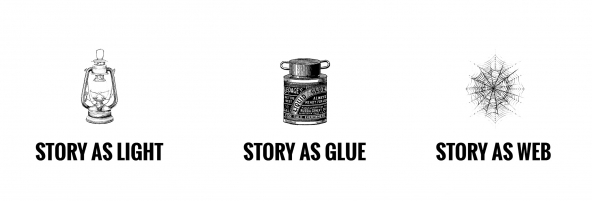
Highlighting the fault lines and how cli-fi novels can move the discussion forward:
see the Cli-Fi Report at www.cli-fi.net
“So you’re the little woman who wrote the book that made this great war.”— Abe Lincoln to Harriet Beecher Stowe
When Uncle Tom’s Cabin was first published in 1854, it outsold that year’s Bible sales. Printing presses stayed open 24 hours a day to keep up with public demand for the book that is often called “the first bestseller.” Written by abolitionist Harriet Beecher Stowe, its emotional portrayal of the cruelty of slavery in the United States roused abolitionist support in the North and galvanized the South to fiercely defend it, leading to Lincoln’s legendary (if unverified) comment in the midst of the Civil War. While the book’s treatment of race has since come under fire, its systemic significance is incontrovertible.
Let me illustrate the role of story in changing a system. Stories make, prop up, and bring down systems. Stories shape how we understand the world, our place in it, and our ability to change it.
Humans have always used stories to make sense out of our chaotic world. When our ancestors had to kill animals they felt were kindred spirits to survive, they created myths to help them come to terms with it. When they invented agriculture, they created myths that glorified graft and highlighted the seasonal nature of existence. When they began to settle, humans created myths imbuing cities with transcendence. As Yuval Noah Harari describes in his book Sapiens: A Brief History of Humankind, story went on to play a vital role in building all subsequent civilizations.
Fast-forward to the volatile times we live in today, where people increasingly recognize that tackling problems like climate change, inequality, and health care requires a systems approach. The work of systems change involves seeing systemically—looking at the elements, interconnections, and wider purposes of systems—and acting systemically. Story plays a vital role in helping us do both of these things.
Story has many different qualities that make it useful for the work of systems change. It’s a direct route to our emotions, and therefore important to decision-making. It creates meaning out of patterns. It coheres communities. It engenders empathy across difference. It enables the possible to feel probable in ways our rational minds can’t comprehend. When it comes to changing the values, mindsets, rules, and goals of a system, story is foundational.
Subscribe to:
Posts (Atom)