A reader writes:
''While much of this book brilliantly exposes the problem we have with coming to grips with climate change -- in many different types of narratives, such as historically and politically -- the one glaring error is Ghosh's assumption that artists and authors aren't properly dealing with climate change in their works. This is so very untrue.
Maybe because I actively research and talk with authors and read these novels and short stories, I am more aware of what's actually happening -- but then that would point to poor research in this area on Ghosh's end.
I agree that climate change in fiction perhaps shouldn't have one particular genre -- that it's the story that counts, despite the newer genres ....readily trying to wrap their hands around global warming and the older genres still doing the job .....
That brings me to another point, that there does exist the assumption in Ghosh's book that literary fiction is the only fiction that matters when it comes to climate change.
Shouldn't this movement be readily open to all readers and writers, regardless of what genre the work is in?
Genre fiction and literary fiction may be miles apart, yet many times the lines are blurry.
No reason to be elitist about genres and their potential impacts, especially when global warming, as a huge crazy reality that everyone finds difficult to grasp and talk about, would seemingly call for a tolerance globally to discuss and immerse artistically in whatever way (journalism, art, fiction, etc.) one can. This is not an issue reserved for only a few people. ''
Thursday, October 27, 2016
Wednesday, October 26, 2016
Ocean Aci-di-fi-ca-tion, Anyone? -- ''RUBY, THE 6 year old Australia CLIMATE KID'' on Ocean Acidification -- [BLOG POST]
Ocean Aci-di-fi-ca-tion, Anyone? --
''RUBY, THE 6 year old #Australia CLIMATE KID'' on Ocean Acidification Ocean Aci-di-fi-ca-tion, Anyone? --
FROM THE MOUTH OF BABES:
YOUTUBE LINK
http://ln.is/www.youtube.com/NvSDj
6-year old Australian girl ''RUBY, THE CLIMATE KID'' makes a NEW video about Ocean Acidification after she learns that Margaret Atwood feels very strongly about the issue
Ocean Aci-di-fi-ca-tion, Anyone? --
Meet Ruby the Climate Kid - a Gamilaraay girl fiercely passionate about saving the planet Ruby, age 6, is an avid reader of environmental newsletters and non-fiction books about wildlife. She is influenced by scientists and researchers such as, Neil deGrasse Tyson and David Suzuki and in particular, she lists Sir David Attenborough as her hero.
She says, "Ever since I was a baby Sir David has been teaching me about nature and how to protect it." As an Indigenous Australian, Ruby says she was taught that plants and trees care for humans, if humans are willing to care for them - if a person talks to a plant, it will eat their carbon dioxide and give you things in return; food, healing or simply oxygen. In order to save the planet, Ruby is asking people to follow her 'Climate Kid' cause and she will send them one seed to plant a tree.
"We can save the planet together, one plant at a time."
THIS IS RUBY'S MOM:

Natalie Cromb
•Natalie Cromb, IA's Indigenous affairs editor, is a 31 year old woman belonging to the Gamilaraay (or Kamileroi) nation of Burra Bee Dee Aboriginal Reserve, just outside of Coonabarabran in rural New South Wales, and is a proud descendant of Mary Jane Cain who founded the reserve.
• Natalie has lived and worked full-time as a paralegal in Sydney for the last 10 years whilst completing her law and history degrees. She has also been raising her daughter Ruby with her partner and is passionate about passing her Aboriginal culture onto her daughter.
• Natalie is a passionate advocate for Aboriginal people and has, in all stages of her upbringing, held representative positions and been engaged in community organisations and work. Natalie considers the political and judicial systems in this nation to be responsible for continuing poor policy and legal decisions that continue to subvert Indigenous rights. She believes this needs to be brought fully into the light.
Meet Ruby the Climate Kid - a Gamilaraay girl fiercely passionate about saving the planet
''RUBY, THE 6 year old #Australia CLIMATE KID'' on Ocean Acidification Ocean Aci-di-fi-ca-tion, Anyone? --
FROM THE MOUTH OF BABES:
YOUTUBE LINK
http://ln.is/www.youtube.com/NvSDj
6-year old Australian girl ''RUBY, THE CLIMATE KID'' makes a NEW video about Ocean Acidification after she learns that Margaret Atwood feels very strongly about the issue
Ocean Aci-di-fi-ca-tion, Anyone? --
Meet Ruby the Climate Kid - a Gamilaraay girl fiercely passionate about saving the planet Ruby, age 6, is an avid reader of environmental newsletters and non-fiction books about wildlife. She is influenced by scientists and researchers such as, Neil deGrasse Tyson and David Suzuki and in particular, she lists Sir David Attenborough as her hero.
She says, "Ever since I was a baby Sir David has been teaching me about nature and how to protect it." As an Indigenous Australian, Ruby says she was taught that plants and trees care for humans, if humans are willing to care for them - if a person talks to a plant, it will eat their carbon dioxide and give you things in return; food, healing or simply oxygen. In order to save the planet, Ruby is asking people to follow her 'Climate Kid' cause and she will send them one seed to plant a tree.
"We can save the planet together, one plant at a time."
THIS IS RUBY'S MOM:
Natalie Cromb
•Natalie Cromb, IA's Indigenous affairs editor, is a 31 year old woman belonging to the Gamilaraay (or Kamileroi) nation of Burra Bee Dee Aboriginal Reserve, just outside of Coonabarabran in rural New South Wales, and is a proud descendant of Mary Jane Cain who founded the reserve.
• Natalie has lived and worked full-time as a paralegal in Sydney for the last 10 years whilst completing her law and history degrees. She has also been raising her daughter Ruby with her partner and is passionate about passing her Aboriginal culture onto her daughter.
• Natalie is a passionate advocate for Aboriginal people and has, in all stages of her upbringing, held representative positions and been engaged in community organisations and work. Natalie considers the political and judicial systems in this nation to be responsible for continuing poor policy and legal decisions that continue to subvert Indigenous rights. She believes this needs to be brought fully into the light.
Meet Ruby the Climate Kid - a Gamilaraay girl fiercely passionate about saving the planet
Monday, October 24, 2016
Richard Friedman's new cli-fi novel THE TWO WORLDS OF BILLY CALLAHAN has been published, (thanks, for the kind words, Richard)
Richard Friedman's new cli-fi novel @RFwrites THE TWO WORLDS OF BILLY CALLAHAN, (thanks, kind words, Richard, in the first few pages) pic.twitter.com/is8nIRnJ8n

Saturday, October 22, 2016
Szedlák Ádám: Hol a magyar ''cli-fi''?

Szedlák Ádám: Hol a magyar ''cli-fi''?
A blog post from HUNGARY via @kelt
A.L. Brady asks ''Has anyone else noticed how the majority of recent cli-fi novels/story collections focus as much on themes of isolation as problem solving?'' and says ''Cli-fi should definitely be harrowing, but it's troubling to see so much anxiety channeled into visions of isolation instead of teamwork.''
Photo by Yann Quero, titled "The Madonna of Global Warming"
A.L. Brady tweets at @ingredient_x
''Cli-fi should definitely be harrowing, but it's troubling to see so much anxiety channeled into visions of isolation instead of teamwork.''
She adds: ''Has anyone else noticed how the majority of recent cli-fi novels/story collections focus as much on themes of isolation as problem solving?''
GOOD QUESTIONS!
COMMENTS BELOW. DO COMMENT!
NOTE: She is managing editor at @indianolareview. And has bylines in @lithub, @villagevoice, @the_rumpus, @awl, @the_millions, @mcsweeneys. @LAReviewofBooks and is a NBCC member.
[And tweets from New York.]
Friday, October 21, 2016
''That Continual Hmmmmm'', a literary oped by Sven Birkerts
That Continual Hmmmmm
by Sven Birkerts
I'm fascinated by the waxing and waning of words and usages and of the concepts that underlie them. What is it that first puts a notion on everybody's lips, and then later makes it eye-roll material as soon as it hits some indeterminate expiration date? Who decides? Is it just a matter of saturation? If that were true, our political life would have expired long ago. Maybe it did.
The word on my mind today is "voice," and it's there because after years and years of not daring (or wanting) to use it - it had become such a cliché in the writing world: you need to find your voice, what is the voice doing in this piece? - it suddenly sounded plausible again. Just recently someone asked me to talk about voice in essay-writing and I didn't even flinch.
 | 
|
And now it's in my thoughts. When I asked myself what I wanted to write in this newsletter, it showed up again. Voice.
On September 1st the submissions gates, closed since the end of May, opened again. Really, they burst wide. It happens every year, but I somehow forget, and then comes the morning when I feel like the manager at Best Buy unlocking the door for the Black Friday sale. The submissions are there in the hundreds. My laptop all but vibrates from the pent-up content. And the work begins. Happy work, I should add. Because after a quiet summer I'm rested, ready to listen.
Did you get that? I didn't say "read." I said listen. Because that, I realize, is what I am doing. I open a file and move my eyes along the words, but the eye is conduit to the ear. I am focusing my attention as the sounds arrive. I am waiting to be reached by a ... voice.
It's a tricky business to say what I mean here. Obviously not every string of words and phrases arrives as a voice. In fact, very few do. And of those, fewer still come in on the frequency that we think of as ours - AGNI's. I'm talking less about good and bad - though there is much to be said there, too - and more about a piece of writing being in accord with an aesthetic. Which is...? Which is what a journal, any journal, is finally about. Its aesthetic is what gives it its reason for being. That aesthetic is a worldview as it is represented in an artistic medium. It is what is being expressed and, every bit as important, how it is being expressed.
But even this feels like such a tentative sketch of a definition. How to get in closer? Ten different journals can espouse the same basic ideas about our world today and have as many different aesthetics. This business is all about gradations and the distinction needs to be made sharper.
I suppose it comes down to questions of emphasis - where in our assessment of reality we let the accents fall. And this, in turn - how not? - comes down to the collective personality and temperament of the screeners and editors.
We work together - and keep working together - because we share essential affinities. These are manifest in our responses and judgments. They are implicit in the way we talk about stories, essays, and poems. It is, I know, the same with the readers and editors at other journals - whether it's The Virginia Quarterly Review or The Paris Review. And as they say in Paris: Vive la difference!
All of which brings me back to the opened gate, the influx of submissions, and the mysterious process that is listening for voice.
Voice is, most simply, identity as transmitted through words and their tones; it is a distinct vibration that communicates the feeling of an authentic other life. Voice need not be confiding or confessional. What matters is the authenticity, that it come across as self-consistent and unique. Not the sound of an admired other, or of a prevailing tendency or a workshop consensus, but the expression of an independent sensibility experiencing of the world.
There is sure to be some dissent here. I know that my definition is partial and somewhat off-the-cuff. But it's what strikes me now, in this reading season, as I draw a breath and look away from the unbroken column of submissions on my screen. As I try to figure out what it is, when I've been going No, No, No, No, that makes me pause and say Hmmm. What elicits that low hum of interest?
I can say it's very seldom a complication of story - that comes later - nor is it usually the delivery of some unexpected universal truth. Far more likely it's a sound that seems real: a sound belonging to a voice that does not seem calculated, that is not forcing the issue (whatever the issue is) for effect, but rather letting it reveal itself. That voice can be talking about the most unlikely things. Indeed, I can be more readily seduced by the right description of a knife cutting the rind off a melon than by the rendered screams of a feuding couple. Not to say that those can't be the most wonderful grist - of course they can - but they succeed only when the scene is set and the tone is right, and for that the writer needs...
I'm taking my instances from fiction, but the principle applies with all the written genres. It's a "know it when I see it" business, but this does not mean it happens by chance. Rather, it is a subtle sub-threshold event in which the tuned-up readerly instincts recognize and react to the many elements - rhythm, tone, syntax, and diction among them - that make up a voice. The reader's first - but also determining - response reminds me of what Keats said about axioms in philosophy: that they "are not axioms until they are proved upon our pulses."
This is what my ongoing search for the Hmmm is about. Though it demands hours of often thankless reading, it repays with the sudden surprise of connection, which I will insist is the pleasure of an immediate encounter and confirmation that the system works, that the right words in the right order can still deliver.
Thursday, October 20, 2016
A New Zealand newspaper in 1912 anticipates the global warming potential of burning coal! -- A NEW YORK TIMES RECAP from Revkin's DOT EARTH blog!
UPDATED: NEW YORK TIMES RECAP
A New Zealand newspaper in 1912 anticipates the global warming potential of burning coal! -- A NEW YORK TIMES RECAP from Revkin's DOT EARTH blog!
DOT EARTH POST HERE:
https://t.co/6rx86KqIiM
--------------------------------------------------------
Andy Revkin @Revkin New York, USA
An authenticated New Zealand newspaper clipping from 1912 that anticipates the global warming potential of burning coal is authentic: SEE SNOPES APPRAISAL BELOW:
 Claim: A 14 August 1912 article from a New Zealand newspaper contains a brief story about how burning coal might produce future warming by adding carbon dioxide to the atmosphere.
 True
Further attesting to its authenticity (and perhaps its role as a bit of stock news used to fill space) is that an identical story had appeared in an Australian newspaper a month prior, in the 17 July 1912, issue of The Braidwood Dispatch and Mining Journal, as found in the digital archives of the National Library of Australia.
Some online commenters expressed skepticism over the notion that such a clear understanding of the mechanisms relating to greenhouse gases existed in 1912 or that anyone back then then would suggested that humans could play a role in altering their concentration. In fact, the timing of these news clips is consistent with the historical record.
The first person to use the term “greenhouse gases” was a Swedish scientist named Svante Arrhenius in 1896. In a paper published that year, he made an early calculation of how much warmer the Earth was thanks to the energy-trapping nature of some of the gases in the atmosphere. Even at this early stage, he understood that humans had the potential to play a significant role in changing the concentration of at least one of those gases, carbon dioxide (carbonic acid back then):

http://northwardho.blogspot.tw/2016/10/a-newspaper-clipping-from-1912-that.html
NOTES:
Andy Revkin @Revkin New York, USA
A New Zealand newspaper in 1912 anticipates the global warming potential of burning coal! -- A NEW YORK TIMES RECAP from Revkin's DOT EARTH blog!
DOT EARTH POST HERE:
https://t.co/6rx86KqIiM
--------------------------------------------------------
Andy Revkin
Is this earliest English-language news item on CO2-driven climate change? 1912, N.Z. ht> blogger Dan Bloom via @do_you_cli_fi
An authenticated New Zealand newspaper clipping from 1912 that anticipates the global warming potential of burning coal is authentic: SEE SNOPES APPRAISAL BELOW:
Yes, a newspaper clipping from 1912 that anticipates the global warming potential of burning coal is authentic and consistent with the history of climate science.
True
Example: [Collected via Facebook, October 2016]
Origin:On 11 October 2016, the Facebook page “Sustainable Business Network NZ” posted a photograph of a clipping from the 14 August 1912 edition of the Rodney and Otamatea Times, Waitemata and Kaipara Gazette that included a brief item headlined “Coal Consumption Affecting Climate”:
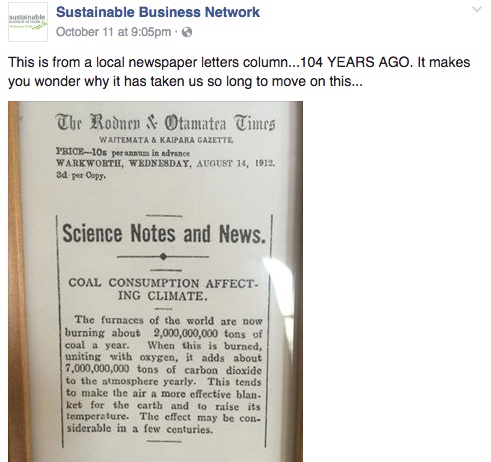
The furnaces of the world are now burning about 2,000,000,000 tons of coal a year. When this is burned, uniting with oxygen, it adds about 7,000,000,000 tons of carbon dioxide to the atmosphere yearly. This tends to make the air a more effective blanket for the earth and to raise its temperature. The effect may be considerable in a few centuries.This article’s authenticity is supported by the fact it can be found in the digital archives of the National Library of New Zealand.
Further attesting to its authenticity (and perhaps its role as a bit of stock news used to fill space) is that an identical story had appeared in an Australian newspaper a month prior, in the 17 July 1912, issue of The Braidwood Dispatch and Mining Journal, as found in the digital archives of the National Library of Australia.
Some online commenters expressed skepticism over the notion that such a clear understanding of the mechanisms relating to greenhouse gases existed in 1912 or that anyone back then then would suggested that humans could play a role in altering their concentration. In fact, the timing of these news clips is consistent with the historical record.
The first person to use the term “greenhouse gases” was a Swedish scientist named Svante Arrhenius in 1896. In a paper published that year, he made an early calculation of how much warmer the Earth was thanks to the energy-trapping nature of some of the gases in the atmosphere. Even at this early stage, he understood that humans had the potential to play a significant role in changing the concentration of at least one of those gases, carbon dioxide (carbonic acid back then):
The world's present production of coal reaches in round numbers 500 millions of tons per annum, or 1 ton per km of earth's surface. Transformed into carbonic acid, this quantity would correspond to about a thousandth part of the carbonic acid in the atmosphere.Though he didn’t explicitly say in that paper that human activity could warm the planet, Arrhenius would go on to make that argument in later works. A 2008 tribute to Arrhenius published by the Royal Swedish Academy of Engineering Sciences stated that his ideas about coal and climate were popular and well known in his day but fell out of favor for a while after his death in 1927:
While Arrhenius’ prediction [of warming] received great public interest, this typically waned in time but was revived as an important global mechanism by the great atmospheric physicist Carl Gustaf Rossby who initiated atmospheric CO2 measurements in Sweden in the 1950s.In this sense, the content and date of the newspaper clips in question are consistent with both what was known to scientists about greenhouse gases then and what the general public was interested in at the time.
Originally published: 18 October 2016
http://northwardho.blogspot.tw/2016/10/a-newspaper-clipping-from-1912-that.html
NOTES:
Andy Revkin
Is this earliest English-language news item on CO2-driven climate change? 1912, N.Z. https://paperspast.natlib.govt.nz/newspapers/ROTWKG19120814.2.56.5 … ht> Dan Bloom via @do_you_cli_fi_pic.twitter.com/FTD0pF43YA
- Andy Revkin Retweeted
@Revkin@dotearth@pashulman Parts of the 1912 Popular Science article that was the source of the NZ clipping on coal and global warming.pic.twitter.com/7Io1TQbqaR


- 2 retweets 2 likes

- .
@Revkin Marshall County Independent, Indiana, November 17 1899:pic.twitter.com/Fg6LTLDtek 
- 39 retweets 29 likes


- 4 retweets 2 likes

- 15 retweets 10 likes

- .
@OpenDebate blasts@andersoncooper &@MarthaRaddatz for cherrypicking "to give their own questions the veneer of representing the public"pic.twitter.com/JgqD17Q6oH 
- 5 retweets 2 likes

- News Coverage of Coal's Link to Global Warming, in 1912 http://nyti.ms/2etza0y
@dotearth Seeking older stories.pic.twitter.com/K6GLZCv9Nk 
- 641 retweets 508 likes

Subscribe to:
Posts (Atom)