AN INTERVIEW WITH Professor Marc DiPaolo, author of
''FIRE AND SNOW
Climate Fiction from the Inklings to Game of Thrones''
PUBLISHER LINK
http://www.sunypress.edu/p-6585-fire-and-snow.aspx
DAN BLOOM: Who is your intended audience for this book?
MARC DIPAOLO: I’ve found that more and more genre fans and informed general readers are interested in the serious
academic study of popular culture and contemporary politics. The last book I wrote, War, Politics and
Superheroes (2011), sold very well for an academic title, and seems to have been read by as many
impulse buyers as cultural studies scholars. Knowing this, I’ve tried to make this book an engaging read
for anyone interested in literature, film, television, comics, religion, politics, science, ecology, and
feminism – and not necessarily in that order. Obviously, I write to get respect as an academic, but I also
write from my heart for myself – and in the hopes that I might get my family members to read more
than a page or two of it. (In fairness, mom read four or more drafts of it during the five years I spent
working on it.)
2. You teach in Oklahoma and book published by SUNY press in new York. Did u have an agent or how
did SUNY get hold of book. Who was your editor there?
I went to SUNY Geneseo as an undergraduate, so I have a soft spot for anything SUNY. It was the perfect
press for me because they respected my academic freedom and didn’t reign in my efforts to blend sober
academic criticism with passionate environmental activism.
3. What kind of book promotion and pr publicity will you do for the book? Radio interviews, newspaper
interviews, podcasts, tv interviews, blog interviews, religion websites, climate activist websites, literary
websites like lithub, Chicago Review of Books, nytimes, BBC, TOR website, locusmagazine, ? More?
I’ve been interviewed by Cris Alvarez for his podcast “The Art and Design of Sci-Fi and Fantasy, Mystery
and Horror,” by Frederic Murray for SWOSU’s BookGrowl, and by Umapagan Ampikaipakan on BFM
radios’ “Bookmark,” and I will be on Rev. Paul John Roach’s “World Spirituality” program in February. I
have some hopes of catching Stephen Colbert’s attention since he is discussed in the book, is a Catholic,
and a Tolkien fan and notable portions of the book are about Tolkien and Catholic environmental
thinking. Beyond that, I’m not too savvy about knowing how to bring my book mainstream attention.
Thankfully, the $30 softcover just came out, so it will be more available for the general public than the
$95 hardcover marketed for college libraries.
4. Your book is a kind of movies and literary "call to action" about climate change in 2018, 2019. Can u
explain how you came to this concept for a book like this, both academic and activist?
I’m a native New Yorker who moved to Oklahoma about ten years ago. I’ve loved many things about
living in this state and I’ve made so many wonderful friends, but the omnipresence of climate change
denial and the frequency of man-made earthquakes alarmed me right away. After all, it is no accident
that most of the individuals that Trump appointed to powerful government positions specifically to gut
environmental regulations and climate science research hailed from this state. The part of me that likes
to flee from this kind of dispiriting reality looked to science fiction and fantasy for escape, and a few
years back I immersed myself in the Middle-earth books, the Narnia series, and Game of Thrones.
Amusingly, if I was looking for escape from my pollution phobia, I had chosen EXACTLY the wrong books
to read! By the time I was finished with the three sagas, I decided that they were all stealth
environmental allegories with a lot to say about the very real 21 st century world I was living in. Once I
started thinking in these terms, I sought out books that I assumed were part of the same broad genre.
(At the time, I didn’t know it had a name.) I read the MaddAddam trilogy by Margaret Atwood, Philip
Pullman’s His Dark Materials trilogy, Suzanne Collins’ Hunger Games series, and Octavia Butler’s Parable
books. I was consistently amazed by how well all of these books thematically linked together whether
they were science fiction or fantasy, written by religious authors or agnostics, and were deliberate
ecological narratives or (somewhat) unintentional works of climate fiction. Once I knew what books
formed this interconnected canon, and once I saw direct parallels between the heroes and villains of
these works of fiction and real-world figures, all I needed to do was find my methodology and my thesis.
It was a rewarding and somewhat unexpected journey.
5. Noahs ark 2012 magic lifeboats for the wealthy. Can you tell me more about this chapter?
There has been a trend in recent blockbuster action movies to provide the main villain with an ecological
reason to fire off his doomsday device. While Dr. Evil was willing to launch nukes just to make some
money – he was blackmailing the world to pay him one-hundred-million-dollars – Thanos planned to use
the Infinity Gauntlet to vaporize one half of the population of the universe because he’s a Malthusian.
Villains like Marvel’s Thanos are showing up in novels such as Margaret Atwood’s Oryx and Crake and
Dan Brown’s Inferno, as well as popcorn fare like Aquaman and Kingsmen: The Secret Service. In these
particular stories, the ecoterrorist who sets himself up to choose who lives and who dies is the one
causing the disaster. In contrast, in the movies 2012 and Snowpiercer, the rich businessmen who see the
apocalypse coming didn’t cause it with a doomsday device, but they were only concerned with saving
themselves; they made arks and fortified bullet trains to keep them and their rich friends safe while they
let the poor of the world die. In that chapter, I ask the question: “To what extent is this kind of thing
already happening in the real world?” As I look for answers, I consider the potential fate of the Maldives,
Naomi Klein’s Shock Doctrine, Exxon’s recently-exposed campaigns of climate denial (even as they have
reportedly made plans for higher sea levels in their oil rig designs), and other journalistic data that make
these films seem more like documentaries than works of speculative fiction.
6. Do you see snowpiercer as cli-fi movie or sci-fi movie or new kind of hybrid? Explain
I also discuss Snowpiercer in a chapter about the religious imagery that fascist rulers cloak themselves in
as they take away people’s freedom, steal natural resources, and create harems for themselves. I had
some trouble threading the needle when it comes to making distinctions between fantasy, science
fiction, climate fiction, speculative fiction, and so on. To a degree, since my desire is to break down walls
between academic disciplines, religious sects, high and low culture, and the sacred and the profane, I
don’t worry too much about where one genre ends and another begins. After all, I’m in cultural studies
and can theoretically teach in any of the following academic departments: Literature, Communication,
Film Studies, Religious Studies, Honors, etc
.
Still … this section of the book may best answer this question, as well as a couple of those below…(Note:
When I copy and paste out of a PDF, some security measure sometimes deletes letters and creates typos
that aren’t in the book)
Since climate fiction—or everything fiction—straddles multiple genres, genre
criticism terminology is important to clarify as well. When the real‑world issues of the
wages of pollution are depicted as taking place in a reality much like our own, but the
story itself is a narrative conceit, the work is climate fiction but not speculative fiction.
When these issues that touch us in our reality are dramatized as taking place in Westeros,
Panem, Middle‑earth, or other such invented worlds, the climate fiction is taking place
within the realm of a speculative fiction narrative, but we have the right to draw several
notable parallels between the events taking place in these fictional worlds and the ones
unfolding in our own. It is also possible to find works of climate fiction by climate
change deniers—with the late Michael Crichton’s State of Fear (2004) being the most
notable work by the world’s most famous climate change denier. However, most works
in this vein accept the truth of climate change and consider its ramifications in a series
of “what if” scenarios. This does not always mean that a well‑meaning environmentalist
cli‑fi writer will always get the climate science right—The Day After Tomorrow has often
been ridiculed for its bad science and good intentions—or offer a solution that climate
change activists would approve of—for example, the defeatist and improbable plan to
abandon the Earth in Interstellar.
Returning to the issue of terminology: several of Lewis’s fantasy novels set in the
land of Narnia may be considered speculative fiction because they featured worlds that
he designed, but they are also climate fiction because of their apocalyptic ecological
concerns. Notably, the Narnia novels are not science fiction. However, Lewis also wrote
The Space Trilogy (aka The Ransom Trilogy), a series of Christian science fiction novels.
These books are also treated as works of climate fiction in this study, with book three,
That Hideous Strength, a frequent touchstone.
Whether the climate fiction narrative in question is “secular” or “religious,” or
whether the original book or the filmed adaptation is the focus of analysis, the multimedia
cli‑fi text provides rich fodder for discussion in these environmentally troubled times.
The goal of this book is to show how these popular franchises are recognized (or not
recognized) by the broader public as climate fiction narratives offering critical moral
instruction on the urgency of conservation. The moral urgency of these stories may be
underpinned by overt or covert Christian ethics, a Native American spirituality, or by
a species of secular humanism, but the shared interest in saving our forests and saving
our planet transcends ideological differences and bridges gaps between science fiction and
fantasy texts. Each of these narratives offers up—almost like a musical refrain—images
of trees being destroyed: cut down, burned to the ground, or devoured by monsters.
None of the authors of these works support the mass destruction of trees. The
Christians, atheists, and agnostics who penned these works all agree that we need to put aside
our cultural differences and transcend our personal, socioeconomic circumstances to work
together to save our environment. These stories show us how
7. Many pundits have said GoT is about climate change. Do you agree? In what way?
I end the book with Game of Thrones because I see so many threads in climate fiction leading up to this
story. The Wall across Westeros and the Wildling refugees being left to die speaks both to the cli-fi
genre convention of “magic lifeboats” as well as the Syrian and Puerto Rican refugee crisis and the
entire MAGA ethos. (And the “magic lifeboat” metaphor will work especially well in the event that we
see Cersei Lannister holed up in the Red Keep as she lets everyone else be eaten by ice zombies.) The
book series is as inspired by Narnia and Lord of the Rings as it is by I Claudius, Earthsea, Richard III, The
Cat People, V, and even the original Star Trek.
From F&S (with some possible typos…)
Initially, Martin seemed reluctant to grant the climate change interpretation of his books credence or
own that climate change concerns were a primary motivating force in his writing the Westeros books.
Consequently, during a question‑and‑answer session for fans at Dymock’s Literary Luncheon in Sydney,
Australia, in 2013, he said, “Like Tolkien I do not write allegory, at least not intentionally. . . . [I]f I really
wanted to write about climate change in the 21st century, I’d write a novel about climate change in the
21st century.” More recently, the liberal Democrat and frequent critic of the Trump administration has
embraced the interpretation. In a 2014 interview with Al‑Jazeera America, he said that his work has
tremendous contemporary relevance because climate change is “ultimately a threat to the entire world.
But people are using it as a political football instead of . . . [getting] together.”
8. Does the reader have to be a believing practicing Christian to get the most out of the book, or is it also
geared for non Christians around the world who follow Buddhism or Shinto or Hinduism or Islam?
The book is very concerned with British and American literature and popular fiction, and many of my
friends in ASLE and MELUS will be annoyed that it doesn’t have more of a world-literature component.
That is my shortcoming. I grew up in the 80s when multiculturalism was Mr. T and George Peppard in an
attack helicopter together smoking cigars. I remain a work in progress. Still…
I grew up fairly centrist/center-right but I had a political awakening reading, of all things, the National
Review canon of literature. Jane Austen (of all people) introduced me to feminism, superhero comics
taught me about civil rights and to question the doctrine of humanitarian interventionism, the Victorian
gentleman adventurer Doctor Who taught me to be an environmentalist, and C.S. Lewis rescued me
from Opus Dei Catholicism and pushed me towards liberal Catholicism. Reading Lewis is supposedly a
safe prospect for American Republicans and Dominionist Christians, but the man’s work is filled with
subversive sentiments about animal rights, environmentalism, birth control, and homosexuality. His
sentiments would be insufficiently liberal for anyone who grew up listening to punk rock and reading
Anais Nin, but I grew up with the A-Team and Ronald Reagan, so a center-left Christian like Lewis was a
revolutionary figure for suburban, Generation X Marc DiPaolo. Meanwhile, as heretical as Lewis’
thoughts may seem, he couches them in very thoughtful, legitimate lay theology, so he represents an
authentically Christian school of thought. Nobody seems to know this about him. He disgusts most
liberals I know who have no time for his piety, his occasional male chauvinism, or his frequent
Orientalism. Meanwhile, his evangelical readers seem to have not read any of his most assumption-
questioning texts. Tolkien is in much the same boat (though some people are old enough to remember
way back when he was loved by hippies during Vietnam). The recent Peter Jackson films did yeoman
work convincing the world that Tolkien was a proto-neoconservative and he became of darling of the
alt-right. My book is an attempt to correct these assumptions about the Inklings and note that these
anti-fascist Christians are a better ideological fit with contemporary ecofeminists and cli-fi writers than
their biggest, far-right-wing fans of the moment – especially Tolkien fan Steve Bannon – want to paint
them as being. I’m not saying that Atwood and Ursula Le Guin would necessarily get along with Tolkien
and Lewis at a dinner party, but they’d all get along better with one another than they would with Steve
Bannon.
9. Margaret Atwood figures prominently in your book too. She says she does not write sci-fi but
speculative fiction. Do you agree with her pov or if not in what way disagree?
I think Atwood is more concerned about the connotations of these terms than the definitions, per se. If
– in the minds of most casual observers – “sci-fi” is a male-dominated genre about fighting cool battles
in space and is somewhat juvenile in tone then no wonder it isn’t a label she is in a hurry to self-apply.
Personally, I would argue that a case could be made to place either label upon her work.
Atwood has three main sources of import to my book. First of all, she appears as one of the thinkers
who helped define and popularize the genre of cli-fi, and her descriptions of “cli-fi” and climate change
as best understood as “everything change” help set up the whole book in the introduction. (Someone
named Dan Bloom also gets a shout-out.)
I also discuss The Handmaid’s Tale and MaddAddam as key cli-fi texts, show their relationship to the
works of the Inklings, discuss them as ecofeminist texts, and consider the ways in which they could be
regarded as “documentaries” about modern America as much as they could be read as works of
speculative fiction.
Finally, Atwood’s thoughts on the relationship between fascism and far-right-wing Christianity, and her
discussion of the significance of Thoreau as an important American thinker and patriot in need of
widespread rediscovery are deeply significant to the book. Those themes are at the heart of its
meditation on competing cultural narratives and the role of religion in American politics.
10. Cli-fi is a new literary and movie term for novels and movies about climate themes. A nickname
shortening of climate fiction. How did you first hear of the nickname and does it fit in with the themes
and visions of your book?
I had discovered several key works of cli-fi by accident before I had even heard the term cli-fi. I knew I
wanted to write about all of these texts, but I didn’t know how to justify including such diverse texts in
one book. After all, I had wanted to examine both films and books, works from Britain and the Americas,
and works of science fiction and fantasy. While the humanities are becoming more interdisciplinary in
theory, in actual practice, many academic publishers like to know who they are marketing to (“Is this
book film studies or political science or…?”) and many course offerings at universities are still fairly
traditional and organized by national literatures and specific time periods and literary movements. I was
worried I was sunk. I was on the verge of calling the selection of franchises I wanted to examine the
“Don’t Cut Down Trees!” multimedia canon – or “Lorax-Lit” – when my friend Christopher Gonzalez,
Director of the Latinx Center at Utah State University, sent me an article from the Chronicle of Higher
Education about cli-fi’s growing role in English Departments. He knew it would be a good source for me,
but I don’t think he realized how key a favor he did me, casually sharing this life-saving text on my
facebook page. Now I knew I wasn’t smoking something, and the book was suddenly viable. I mean, I
suppose I might have found it all out eventually, but maybe not. At the very least, Chris saved me a LOT
of time and hand-wringing introducing me to the term “cli-fi.” (Thanks, Chris!) Also, my friend William
Murphy, a historian at SUNY Oswego, was the one who helped me make sense of Tolkien’s Silmarillion.
(Thanks, Bill!) It takes a village of friends, fans, and academics on facebook to write a book like this.
Thursday, September 20, 2018

Tuesday, September 18, 2018
NEWS FROM Cli-Fi Movies blog: -- 17 FREE cli-fi movies online -- The first English Cli-Fi movie series for Cinemateket online from Denmark - thank you Sophie!

NEWS FROM Cli-Fi Movies blog: --
17 #FREE cli-fi movies online
The first English Cli-Fi movie series for Cinemateket online from Denmark -
thank you Sophie!
https://korgw101.blogspot.com/2018/10/17-free-cli-fi-movies-online-first.html
=======================
P.S.
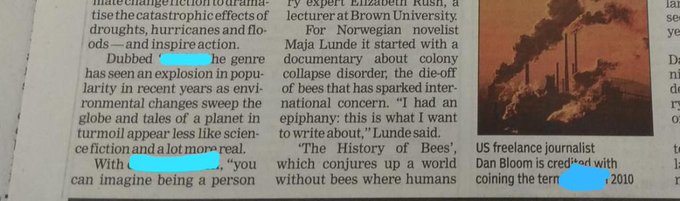
AFP news article taken from the TIMES OF INDIA print newspaper (screen shot)
ENGLISH VERSION IS HERE:
https://au.news.yahoo.com/climate-change-fiction-novelists-aim-radical-empathy-094854718--spt.html
Set for November release in India and set to screen at film festivals world-wide. See korgw101.blogspot.com
Odia-language cli-fi movie "Kokoli" from India explores climate change issues in coastal regions
Love in a time of climate change? A new cli-fi Indian film puts cli-fi on India's map, following in the footsteps of Amitav Ghosh's novel ''The Hungry Tide''.
Doing away with typical Bollywood movie storylines of young lovers facing family opposition, an upcoming Indian cli-fi film set for release in November 2018 instead features a couple battling climate change in order to be together. The movie uses the Odia language in the film. Subtitles will be available in English as well.
"Kokoli" -- the name of the female character in the movie and also a type of fish -- tells a story of a fishing community along tbe coast of India facing the loss of livelihoods and land as sea levels rise in due to climate change and global warming the eastern Indian state of Odisha. The Odia-language movie will be released in November.
The Odia-language film centers on Miss Kokoli and her boyfriend, who sets out to build a wall to keep towering waves from destroying and uprooting his village - a task he must succeed at in order to win her mother's approval. Romance? Yes.
"Fishing is the only livelihood for them and the only skill they know. They are victims of climate change," filmmaker Snehasis Das told reporter Annie Banerji for the Thomson Reuters Foundation.
"Simultaneously, I focus on how love - a relationship - can be disturbed due to calamities," said the 43-year-old director. "It is a lot about how they adapt to love and climate change. Their future hinges on adaptation."
With a nearly 500 km (300 mile) coastline, Odisha state is home to many coastal communities that depend on the sea.
The state is also one of India's most vulnerable to the effects of global warming, hit by rising sea levels, cyclones and floods, with vast stretches of the shoreline being lost to erosion.
In June, the state government warned in a report that fishermen's catches could plummet with rising temperatures.
India faces the most severe threat from climate change, followed by Pakistan, the Philippines and Bangladesh, a survey showed in a March 2018 survey of 67 countries.
UPDATE:
Award-winning Indin documentary filmmaker Mr Snehasis Das and actress Miss Gargi Mohanty have joined hands for the upcoming film ‘Kokoli – fish out of water’.
Produced under the banner of The Naked Eye in association with Ckinetics, the film reflects the displacement of the fishermen community due to soil erosion in coastal Odisha.
“The impact of climate change has distressed people in the coastal areas. Though a love story, the film has a strong social message. To give a realistic feel, the film has been completely shot near the beach and Penthakata slums in Puri,” said Snehasis, who has earlier worked with Gargi in ‘Spandan’, based on organ donation.
The title ‘Kokoli’ derives from a sea fish of the same name, played by Gargi. “Her happiness has been ruined by calamities and her struggle is the story of the film,” added Snehasis, who is planning to send it for festivals apart from releasing it in theatres. The film’s cinematography has been done by Srikant Pattnaik while editing will be done by National Award winning Prashant Naik. The only song in the film has been taken from an earlier album of Odisha’s melody queen, Trupti Das.
“Climate change has affected many families. My love gets victimised when families shift back due to soil erosion. The struggle to get united with my lover against all hurdles makes the character stronger, which is the essence of the character,” said Gargi, whose claim to fame is ‘Krantidhara.’ Gargi has always chosen strong scripts over commercial stories.
“Good scripts have always attracted me as there is much to learn on the set. As an artiste, I want to grow with every single project,” added the actress, who discontinued the television mega serial which propelled her career, to give complete focus on the character of Kokoli.
Tuesday, September 11, 2018
How the cli-fi term since 2012 grew step by step to be the international literary genre it is today.

Since 2012, the global landscape of cli-fi cultural websites has been chock full of news about thousands of fictional creations, in print and on the silver screen, talking about the global impact of human-induced climate change. In academia as well as in pop culture, this rapidly growing body of novels and movies is now commonly referred to by the catchy linguistic portmanteau ''cli-fi,'' a term coined by an American climate activist named Dan Bloom living in Asia and monitored worldwide on social media and the internet via his dedicated website ''The Cli-Fi Report'' at www.cli-fi.net
That cli-fi has transitioned from a colloquial term coined by a lone blogger working independently in Asia and circulating around the blogosphere into a cultural buzzword can be seen, to name but a few examples from a long list, by its recent addition to the Oxford Dictionaries, its appearance in numerous international conferences and academic publications, the daily blogging of Bloom at his cli-fi-books.blogspot.com site, his personal encouragement of the establishment of Amy Brady’s monthly ''cli-fi trends'' column, “Burning Worlds,” examining cli-fi novels and trends (Chicago Review of Books), and the increasing inclusion of cli-fi as a label in newspaper and internet articles and marketing strategies by publishers and movie studios.
In addition to the many cli-fi mentions in the media worldwide, there are also journalistic mentions of cli-fi novels and movies. Now more than 100 colleges and universities worldwide offer classes in cli-fi novels and movies.
The Cli-Fi Report from its inception was meant to provide an entryway into cli-fi’s many portals. While there is no general agreement on how cli-fi is to be defined, the term itself is understood as Bloom's simple abbreviation of the longer term of ''climate fiction.'' It is an independent, standalone literary genre, as Bloom insists it is, or, is it perhaps a subgenre of ''science fiction'' as some sci-fi literary critics and sci-fi historians opine? Whatever, cli-fi is here and it is here to stay. We can thank Dan Bloom for that.
Without Bloom's constant blogging, tweeting and messaging about cli-fi on Facebook (in addition to an unending and persistent series of cli-fi PR emails since 2012 to hundreds of editors and reporters at internet websites around the world), cli-fi as a term would not exist. He set up the first Wikipedia page for cli-fi in 2013, which has morphed over time to a page now for "Climate Fiction," and he himself in his 70s is actively and energetically engaged 24/7 year-round without any vacations or days off from his computer desk and iPhone. It was his constant PR work since 2012 onward that led to cli-fi's rise in public awareness, and that led to two major New York Times articles in 2014 and in 2017 to a monthly ''cli-fi trends'' column in the The Chicago Review of Books which has also been picked up by the Yale Climate Communications website upon Bloom's recommendation to an editor there.
THE ''Cli-Fi ''REPORT:
Over 1000 academic and media links worldwide now in a variety of languages:
http://cli-fi.net
CliCon2020
planning underway now
READINGS
SIGNINGS
Writing workshops
Climate Communications speakers
Keynote TBA
All-Night Jam
Monday, September 10, 2018
How ''Cli-Fi'' Came to Be What It Is Today: the backstory

How ''Cli-Fi'' Came to Be What It Is Today: the backstory
by staff writer, The New York Stroller
Webposted: October 8, 2018
NEW YORK -- When my editor in New York asked me to fly 17 hours overseas to interview Dan Bloom about his role in coining and promoting the rising new literary genre of cli-fi, his nickname for the longer literary term of ''climate fiction,'' I asked why I couldn't just interview him by phone and email.
"I want you to see him face-to-face for our readers and catch a glimpse of his life as an American climate activist half way around the world," she told me. "Try to find out what makes him tick. Spend a few days talking with him. Who is this guy?"
So it's a long flight sitting in a cramped seat in a crowded 747 from New York. I slept, I had a few drinks, I read some of the news articles and tweets online about cli-fi, and then after landing I had another 5-hour train ride through the rural countryside to Bloom's tiny one-room studio apartment on the 5th floor of a non-descript 8-story building seemingly in the middle of nowhere. I was a bit disoriented and tired after the long jumbo jet flight and train ride, so I checked in to my hotel first and had a good sleep to try to counter the jet lag. My brain was not made for flying, but it was my assignment and I'm a loyal reporter.
I met Bloom, who will turn 70 next year, the next morning in his cluttered studio apartment, and after chatting a bit over coffee, he suggested we go up to the 8th floor rooftop terrace where there was an outdoor sofa to sit on and view a set of majestic 9,000-foot mountain peaks in the distant panorama. It was a fine sunny day, not a cloud in sight. Bloom told me that on some days in the cold of winter, he can see snow on those distant peaks when the skies are clear.
He's almost 70, but he gives off the energy of someone in his 50s.
Dan is an interesting guy. He has no assets and owns nothing. He lives on monthly $300 dollars social security checks that are deposited directly into his local overseas bank account. As for his love life, he said he has been involved romantically in a long series of monogamous relationships since his teens, with women in France, Israel, Japan, Italy, and Alaska, he said, but he never really settled down and owns nothing but a small smart phone that he uses to check his email and Twitter feeds.
''I don't own a computer, never have," he says. "I'm a bit of a modern-day neo-Luddite. I never have used Skype or Zoom or teleconferencing. I'm not comfortable on those platforms. I do all my cli-fi PR work via my Gmail account and with Twitter on my phone screen. It's like science fiction for me. Who knew global communication with fellow climate activists could be so easy with just a phone screen in your hand?"
I watched Bloom do a sample tweet on his screen, sending it into the ethersphere, holding the phone with his right hand and typing letters one by one with his left index finger.
"I like typing one letter at a time," he told me, looking up and smiling. It makes me slow down and choose my thoughts better, carefully."
So I had to ask right away. Where did the cli-fi term come from, and how and why and when, and why does he now spend all his time, seven days a week, no days off and no vacations for the last 12 years, doing his PR lobbying shtick for a simple 5-letter literary term that has, since NPR's five-minute radio segment about cli-fi on April 20, 2013, caught the world's media attention.
https://www.npr.org/2013/04/20/176713022/so-hot-right-now-has-climate-change-created-a-new-literary-genre
"Actually, most people have not heard of the cli-fi term yet," he said. "Maybe 99 percent of the population does not know the word yet. Even in English-speaking nations such as the U.S., the UK, Australia and Canada, most people don't know what the new term means and have never seen it in print. So I still have a lot of work to do, even in retirement, even in my 70s. It's a never-ending, yet rewarding, struggle to push the term into public awareness and try to make it stick. Give me another 20 more years."
Bloom had a heart attack in 2009, and spent a week in an ICU department getting a heart stent. Coupled with diabeties type 2, adult-onset diabetes, Dan told me that while he feels fine -- ''mahvelous,'' he said, smiling. And in conversation, face to face, Bloom is always smiling. I'm not sure why he is always smiling, but a smile always lights up his face. It's weird.
For a guy working with doomsday and climate change issues on a daily basis 365 days a year, I ask him why his personality is always apparently so upbeat and full of a face that's always wearing a smile.
"It's my DNA I think, since I was a kid," he says, adding: "I'm certainly not a 'normal' person, what a normal person. In France I'd be normal person, and I speak French fluently and have loved French literary culture since I was 18, but in America, I never really fit in. That's why I left in 1991. I met a Japanese woman in Alaska that year, fell madly in love and flew to Tokyo to be with her. I sold my car, left my apartment in Juneau and made a new life for myself in Japan."
"The cli-fi term, its coinage, came to me as a result of my never following the rules of a normal life," Dan said. "I was always moving around, I was always on the sidelines, quiet and low-key. I never had a career. I never was interested in getting married, but I'be always had children in my life, nephews, nieces, friends' children and neighbor's kids. I'm still a kid at heart myself. There could be a bit of the Peter Pan syndrome in me. But I love the innocence and playfulness of children. They keep me sane and playful, too."
"I never made any serious money, never had much of a regular yearly income, I've always been mostly an invisible luftmensch,'' he added. ''That's Yiddish for a man with his head always in the clouds. A dreamer, a daydreamer, an idea man. If you look at my life, you might think I'm one big lifelong fail. But no, I've had a very good and interesting life, and I consider myself a roaring success, although a bit on the eccentric and non-disciplained side."
"There are many ways to live," he said. "I chose the road little travelled, less travelled, maybe never-travelled. I've loved every single
day. There must be something wrong with me. But no, I'm kidding, I'm just a normal average everyday American gadfly with a nose for news and an ingrained sense for PR. I had great teachers and mentors early in my life, great parents and brothers and sisters, cousins, aunts, uncles, grandparents. I come from a very sweet Jewish family. I'm lucky in that. I wasn't born with a silverspoon like some of trust fund friends. But I was born with a silver heart, thanks for my family, and that has made all the difference. I owe everything to the people who created me, going back generations, people in America and Poland and Russia. That's why I care so much about the 'iffy' fate of future generations 500 years from now when the Climapocalypse comes. Maybe 30 generations from now. I'm worried for them, not for myself. That's why I do this cli-fi PR work. It gives deep, sustained meaning to my life."
''And then I'll be dead, soon enough, gone with the cosmic wind. It's been a good ride. Absolutely no regrets. 70 orbits around the Sun. Who knew?"
For this, I flew half-way around the world? Whatever, it was fun to meet this guy.
But I still don't know how he came up with the cli-fi coinage. He said he coined it first for press release for a sci-fi writer friend in Texas who had written a cli-fi novel in 2011 about a domed "polar city" in Alaska set in 2085 and titled "Polar City Red."
That's how cli-fi got its media start, in a series of press releases to support a sci-fi novel Bloom commissioned from Tulsa writer Jim Laughter. Stranger things have happened I guess.
"It's not as if I just sat down and came up with a new literary term out of the blue, no," Bloom said. "I was writing press releases to support the publication of a novel I had commissioned as part of my climate activist literary work,in 2010 and 2011. It just happened to be coined by pure chance. I needed a term for Jim's novel. 'Cli-fi' just appeared in my PR mind as a redo of the sci-fi term. I liked it and started using it. A lot. Somehow, for reasons even I cannot really understand, it caught on. Life is like that. I think it was a term whose time was coming. It was in the air. I just plucked it out of the air, zeroed in on its rhyming resonance with sci-fi. It turned out to be an entirely new genre. I also liked the way it sounded when spoken on radio shows and podcasts with a strong 'klai' hard 'clye' like 'eye'sound. That was the clincher for me, the way it sounded when spoken. It sounded strong, brazen, prophetic. I was hooked."
===============================
For more about the Cli-Fi backstory, see ''The Cli-Fi Report'' at www.cli-fi.net
He's almost 70, but he gives off the energy of someone in his 50s.
https://www.npr.org/2013/04/20/176713022/so-hot-right-now-has-climate-change-created-a-new-literary-genre
That's how cli-fi got its media start, in a series of press releases to support a sci-fi novel Bloom commissioned from Tulsa writer Jim Laughter. Stranger things have happened I guess.
"It's not as if I just sat down and came up with a new literary term out of the blue, no," Bloom said. "I was writing press releases to support the publication of a novel I had commissioned as part of my climate activist literary work,in 2010 and 2011. It just happened to be coined by pure chance. I needed a term for Jim's novel. 'Cli-fi' just appeared in my PR mind as a redo of the sci-fi term. I liked it and started using it. A lot. Somehow, for reasons even I cannot really understand, it caught on. Life is like that. I think it was a term whose time was coming. It was in the air. I just plucked it out of the air, zeroed in on its rhyming resonance with sci-fi. It turned out to be an entirely new genre. I also liked the way it sounded when spoken on radio shows and podcasts with a strong 'klai' hard 'clye' like 'eye'sound. That was the clincher for me, the way it sounded when spoken. It sounded strong, brazen, prophetic. I was hooked."
======================================
From the Cli-Fi archives:
''Cool Idea of the Day: 'Cli-Fi' Book Display''
August 23, 2013 SHELF AWARNESS files
During this "sweltering British summer" 2013, Foyles bookstore in London "did something that was a long time coming: It set up a dedicated 'cli-fi' table with a simple yet eye-catching sign promoting fiction and nonfiction books with climate themes," TeleRead in the USA reported.
Among the books displayed were:
Rachel Carson's Silent Spring,
James Lovelock's The Revenge of Gaia,
Stephen Emmott's 10 Billion,
J.G. Ballard's The Drowned World,
John Christopher's The Death of Grass,
Joe Dunthorne's Wild Abandon,
Liz Jensen's The Rapture,
Barbara Kingsolver's Flight Behavior
Ian McEwan's Solar.
We as a humanity of 8 billion people are facing major social collapse as a result of climate change impact events -- but not for another 30 generations (500 years). In the meantime...
An understanding of what we face re social collapse due to climate change in 30 more generations, not now, but in 500 years.....can lead to personal reflection, grieving, transformation and new grounds for action, rather than despair and apathy.
Some of the questions I’ve been posing to myself the past ten years are:
- What do I mean by social collapse? Human caused global warming.
- When will that come? Not for another 500 years, 30 generations from now.
- What should I do in my community?
- Talk about these issues. Write cli-fi novels and produce cli-fi movies.
- Am I counter-productively implying we should give up trying to fight climate change since the major impact events won't happen for 500 more years?
- No no no. Fight fight fight.
- Is my point of view the same as the “survivalist” or “doomer” perspective?
No, it is not. I am not a prepper or a survivalist or doomer.
- Are there spiritual or New Age implications to my perspective?
- That's up to you to explore. I am an atheist, and I believe there is no god or gods and that religion is based on superstions and folk myths. It is of no use to me.
- Am I you a credible and ethical person?
- Sure am!
- What can we do to explore these topics further over the next 500 years? Read below:
In answering such questions, I want to say that I am not an expert but I am sure we as a humanity face an inevitable social collapse in 30 generations from now.
What do I mean by social collapse?
By the term “social collapse” I mean to imply an uneven ending of normal modes of sustenance, security, pleasure, identity, meaning, and hope in 500 years. 30 generations from now.
When will these events come?
In 500 years, around the year 2500 A.D. (anno destructus), some 30 generations from now.
So we need to start thinking now about how our descendants on Earth some 500 years from now can find ways to respond at such a time with bold and imaginative compassion.
We will not see social collapse happening in the West in 5 or 10 years. We need to think long term and not go in for what false prophets say now about the End coming in ten years or 2-3 decades at most. No, we are safe for another 30 generations. But we need to start planning for our descendants and teach them with guide books and novels and movies so that they will be prepred for the Climapocalypse in 2500 A.D. (Anno Destructus)
As a thought experiment, as someone in my early 70s, I am now exploring what a 500-year window will look like. No matter what age you are, you should be exploring these ideas, too.
What should cultural and literary gatekeeprs now do?
They should promote the publication and release of cli-fi novels and movies to explore all this in emotional terms the way art and literature can.
- What do I mean by social collapse? Human caused global warming.
- When will that come? Not for another 500 years, 30 generations from now.
- What should I do in my community?
- Talk about these issues. Write cli-fi novels and produce cli-fi movies.
- Am I counter-productively implying we should give up trying to fight climate change since the major impact events won't happen for 500 more years?
- No no no. Fight fight fight.
- Is my point of view the same as the “survivalist” or “doomer” perspective?
Saturday, September 8, 2018
12 New Literary Agents Seeking Clients with 'Cli-Fi' Novels (in 2018-2019)

Some New Literary Agents Are Seeking Clients (in 2018-2019) And Among Them Some Who Rep Sci-Fi Novels Are Also Looking for Good Cli-Fi Novels as Well. Query Them to Find Out What Might be a Good Fit for You!
See the full blog link by John The Book Fox here and pitch to those agents who are a fit for you!
This post is based on old-fashioned research: He emailed 19 new literary agents seeking to build their client list, and got the inside dish from each of them.
- The type of books they’re looking for
- The type of books they read when they’re not working
- Personal information — their history, hobbies, etc.
Katy Waldman on ''How “Cli-Fi” Forces Us to Confront the Incipient Death of the Planet''


A nice essay by Katy Waldman at The New Yorker on "Warmer," a new collection of 7 short ''cli-fi'' stories about climate change. Stories include one by Jane Smiley about a horse who "befriends one of the last surviving humans in a lush equinocracy bounded by wasteland."
Link to New York magazine:
How Climate-Change Fiction, or “Cli-Fi,” Forces Us to Confront the Incipient Death of the Planet
by Katy Waldman
As part of its ongoing “Original Stories” series, Amazon has assembled a collection of climate-change fiction, or cli-fi, bringing a literary biodiversity to bear on the defining crisis of the era. This online compilation of seven short stories, called “Warmer”—containing work from a Pulitzer Prize winner (Jane Smiley) and two National Book Award finalists (Lauren Groff and Jess Walter), among others—offers ways of thinking about something we desperately do not want to think about: the incipient death of the planet.
There is something counterintuitive about cli-fi, about the fictional representation of scientifically substantiated predictions that too many people discount as fictions. The genre, elsewhere exemplified by Margaret Atwood’s MaddAddam Trilogy and Nathaniel Rich’s “Odds Against Tomorrow,” brings disaster forcefully to life. But it is a shadowy mirror. Literature has always been a humanist endeavor: it intrinsically and helplessly affirms the value of the species; its intimations of meaning energize and comfort. But what if there is scant succor to be had, and our true natures are not noble but necrotic, pestilential? We have ''un-earthed'' ourselves. Yet we claim the right to gaze at our irresponsibility and greed through fiction’s tonic filter. The stories in “Warmer,” which possess the urgency of a last resort and the sorrow of an elegy, inhabit this contradiction. They both confront and gently transfigure the incomprehensible realities of climate change.
READ FULL TEXT VIA LINK ABOVE
Subscribe to:
Posts (Atom)