Tuesday, September 27, 2016

Meera Kumar on how did the ''GREAT AWAKENING'' came about: an annotated review of Amitav Ghosh latest essay collection

Meera Kumar on how did the ''GREAT AWAKENING'' came about: an annotated review of Amitav Ghosh latest essay collection
Original link is here:


The Great Awakening: a personal take on Amitav Ghosh's new climate change essay collection from the University of Chicago Press


Lecture 1, ABOVE VIDEO
and Lecture 2 here  
 
The Great Awakening: a personal take on Amitav Ghosh's brilliant ''new'' climate change essay based on his four 2015 U.C. college lectures from the University of Chicago Press

Here's my take.

First of all: the book will likely reach two main audiences: United Nations IPCC COP 22 climate policy wonks, and assorted climate scientists in state-funded think tanks and universities around the world......AND.......literary critics of all stripes and ideologies in India, the UK, the USA and Australia

Now for my take, with book in hand:

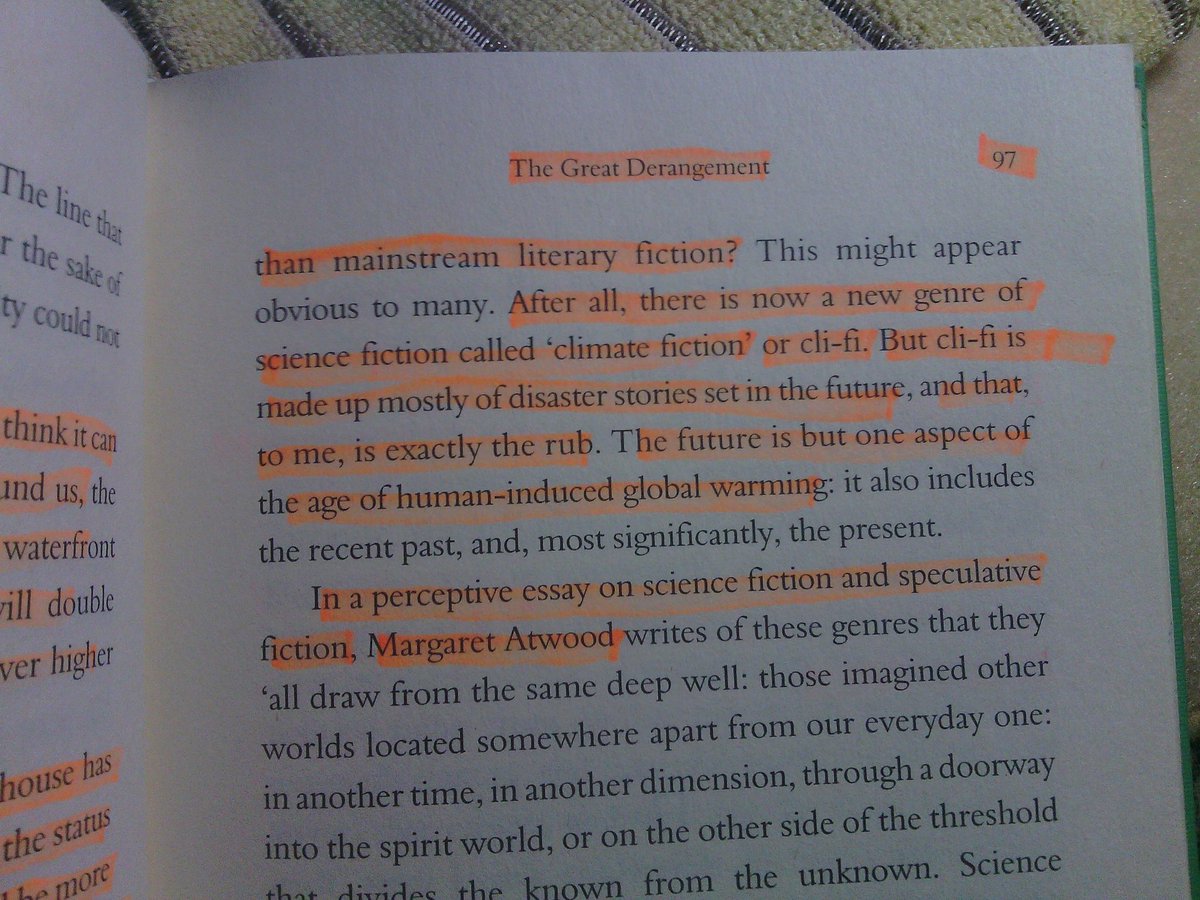
1. It's a great, brilliant, essential and important book about climate change and the ''GREAT AWAKENING'' taking place now among activists around the world, among them Bill McKibben and Leonardo DiCaprio, in terms of creating novels and movies that tackle, head on, climate change issues in sci-fi, cli-fi and spec-fic novels and movies.

2. It's a slight book, even in the hardback edition, about the size in terms of height and width to most paperback books, and the three main chapters are for the most part a rehash of the four Berlin Family Lectures that Ghosh was invited to give at the University of Chicago in October 2015 and rewritten and amplified with over 200 footnotes -- called END NOTES in the bool -- and while it's a slight book, it's also heavy, as in "Yeah, man, what he is saying is heavy, very heavy!"

3. The chapters on politics and history are pitch perfect.

4. The chapter on how Western novelists and movie producers have been tackling climate issues was poorly researched and dropped the ball all the way along. In fact, Ghosh should have called the book THE GREAT AWAKENING, because in fact, that is what has been doing on in Western literature, vis a vis climate change and man made global warming since the 1960s. He hardly mentions this. Oops. In the lectures, he also hardly mentioned it. Double oops.

5. Throughout the entire book, the word EARTH, which stands for the name of our dear home planet called Earth, with a capital E, has been lowercased by the editors, probably in keeping with the style guide of the University of Chicago Press. Alan?  In a book like this, about protecting the Earth, it is a serious mistake to lowercase the word as "earth" throughout the entire book. Wrong, wrong, wrong. I wonder what Dr Ghosh will have to say about this when he finds out?

6. One of the best parts of the book are the 216 END NOTES at the end of the book that are kind of like footnotes but not really footnotes. More like eye-notes. Very good and one of the best parts of the book and worth reading. I read the END NOTES over and over three times! Fascinating stuff there.

7. The Great Awakening is a wake up call for humanity and a wake up call for novelists and screenwriters in the West and in India and worldwide -- Africa and South America and all of Asia, including communist China and free democratic Taiwan, and ''cute'' Japan, too -- to continue waking up and using their skills and talents and voices as artists and writers and poets and film directors and climate activists to keep doing that they are doing: tackling these isuses with their art. So they book is not really about any grea derangement. It's about THE GREAT AWAKENING. Think about that as you are reading it.

[8[. [One irony of irony things that has nothing to to do with Dr Ghosh, since I am sure he had no idea and no knowledge of this, but for a hardhitting leftwing tract that takes strong issue with Western imperialism and colonialism, and pretty much pisses on the entire Anglosphere, whatever that is -- read the book to find out -- the Berlin Family lectures at the University of Chicago which sponsored the four lectures that comprise the book's essense and which stipulated that a book HAD to be published after the lecutres BY the University of Chicago Press -- a brilliant PR and marketing move and a good thing, too, because now we have this book in our hands and BRAVO to Dr Ghosh for having written it, despite its few flaws -- but the irony of ironies is that the the USA philanthropy in Chicago that funded the lectures and the book gives SOME of its money to an imperialist and colonial state in the Middle East, and for a book that attacks imperialsim and colonialism ...to be funded by a philanthropy that does just the opposite, supports imperialism and colonialsm in the Middle East -- and I am sure Dr Ghosh knew nothing about this, although the information has always been on the University of Chicago website for anyone to see -- well, look at this: ''Melvin Berlin and his wife, Randy, a retired lawyer and currently a lecturer in law at the University of Chicago Law School, also support 20 post-combat Israel Defense Forces (IDF) soldiers.'']

[Not that it matters, and it's really not interesting at all, and not part of the book's message at all. But we live in an impure world, don't we? Globalization and imperialism and capitalism and all that! Oy!]

]LINK]:
http://support.ats.org/site/MessageViewer?em_id=17283.0


    • Amitav Ghosh, "Politics," Lecture 4 of 4, 10.07.15
      youtube.com
    • Amitav Ghosh,
    • Amitav Ghosh, "
      youtube.com
    • "History," Lecture 3 of 4, 10.06.15

    • youtube.com


  1. The 2015 Berlin Family Lectures with Amitav Ghosh "The Great Derangement: Literature, History, and Politics in the Age of Global Warming" Lecture one: "Fiction I" September 29, 2015 In the first lecture of the 2015 Randy L. and Melvin R. Berlin Family Lecture Series, renowned author Amitav Ghosh explores the impact of ...
  2.  
  3. The 2015 Berlin Family Lectures with Amitav Ghosh "The Great Derangement: Literature, History, and Politics in the Age of Global Warming" Lecture one: "Fiction II" September 30, 2015 In the second lecture of the 2015 Randy L. and Melvin R. Berlin Family Lecture Series, renowned author Amitav Ghosh continues his exploration ...
    www.youtube.com/watch?v=SvvilBabbog


aka "The Great Awakening" -

Saturday, September 24, 2016

Richard Chen presented this academic paper on ''Cli-Fi'' at a cultural conference in Taiwan in 2014- [FULL TEXT]

NTU Professor Richard Chen presented this academic paper on ''Cli-Fi'' in English at a conference in Taiwan in 2014 -

 http://northwardho.blogspot.tw/2016/09/professor-richard-chen-presented.html -

[FULL TEXT] #CliFi

Friday, September 23, 2016

In “Anthrocene,” Cave seems to draw an ironic parallel between the evolutionary effect of man to his environment, while singing about what it means to be eternally human — love, loss, longing.

The fifth track from Nick Cave & The Bad Seeds' 2016 album Skeleton Tree. The title, “Anthrocene”, is a variant of the proposed scientific term Anthropocene (from Greek anthro- or anthropo- meaning “man” and -cene meaning “new” or “era”).

“Anthropocene” refers to the modern geological era, when human activities such as burning fossil fuels began to have a significant impact on the Earth.

While the concept “anthropocene” began as an academic model, its use has broadened to literature, art and even popular culture.

It’s use by Cave on “Skeleton Tree” somehow seems analogous to the song “Higgs Boson Blues” from his previous album, “Push the Sky Away, where an arcane, but newsworthy idea is treated as a metaphorical device to draw out the composer’s profound emotions.

In "Higgs Boson Blues,” particle physics is used to highlight culture’s strange ability to compress space and time into a dense, meaningless void.

In “Anthrocene,” Cave seems to draw an ironic parallel between the evolutionary effect of man to his environment, while singing about what it means to be eternally human — love, loss, longing.

lyrics

[Verse 1]
All the fine winds gone
And this sweet world is so much older
Animals pull the night around their shoulders
Flowers fall to their naked knees
Here I come now, here I come
I hear you been out there looking for something to love
The dark force that shifts at the edge of the tree
It's alright, it's alright
When you turn so long and lovely, it's hard to believe
That we're falling now in the name of the Anthrocene

[Verse 2]
All the things we love, we love, we love, we lose
It's our bodies that fall when they try to rise
And I hear you been looking out for something to love
Sit down beside me and I'll name it for you
Behold, behold
The heaven bound sea
The wind cast its shadow and moves for the tree
Behold the animals and the birds and the sky entire
I hear you been out there looking for something to set on fire
The head bow children fall to their knees
Humbled in the age of the Anthrocene
[Verse 3]
Here they come now, here they come
Are pulling you away
There are powers at play more forceful than we
Come over here and sit down and say a short prayer
A prayer to the air, the air that we breathe
And the astonishing rise of the Anthrocene

[Outro]
Come on now, come on now
Hold your breath while you're safe
It's a long way back and I'm begging you please
To come home now, come home now
Well, I heard you been out looking for something to love
Close your eyes, little world
And brace yourself
Amitav Ghosh is criticized for his book on WRITING THE UNIMAGINABLE (see reader comment below)

Amitav Ghosh is criticized for his book on WRITING THE UNIMAGINABLE (see reader comment below)


Broadlands


Starting a discussion...

Mr. Ghosh, among others, has misunderstood the situation in Bangladesh with respect to climate change. A 2014 peer-reviewed article in "Climate Risk Management" by Hugh Brammer addresses this. "Bangladesh’s dynamic coastal regions and sea-level rise".
His introduction is to the point..."There is a widespread misconception that a rising sea-level with global warming will overwhelm Bangladesh’s coastal area contour by contour and will thereby displace as many as 10–30 million people in the 21st century e.g., (Gore, 2009; Houghton, 2009). In some accounts, that situation will be aggravated by high rates of land subsidence (Syvitski et al., 2009), a recent doubling of the rate of sea-level rise (Smith, 2012) and rapid, on-going rates of coastal erosion (Vidal, 2013a,b). The accounts given to-date imply that the Bangladeshi people are helpless against a rising sea-level and will be unable to resist the rising water. Those assumptions and descriptions are incorrect. Bangladesh’s coastal area is not uniform, nor is it static. It is dynamic, and so are the people of Bangladesh."
Mr. Ghosh describes Hurricane Sandy as improbable and unprecedented. This is another misunderstanding. A hurricane called "The Long Island Express" devastated the same region in 1938. Wikipedia has described it...
"Hurricane Sandy not the first to hit New York: A 1938 storm 'The Long Island Express' pounded the Eastern Seaboard. The storm formed near the coast of Africa in September of the 1938 hurricane season, becoming a Category 5 hurricane on the Saffir-Simpson Hurricane scale before making landfall as a Category 3 hurricane on Long Island on September 21. Long Island was struck first, before New England, Vermont, New Hampshire and Quebec, earning the storm the nickname the ‘Long Island Express’. The winds reached up to 150 mph and had waves surging to around 25–35 feet high.[The destruction was immense and took a while to rebuild. The western side of the hurricane caused sustained tropical storm-force winds, high waves, and storm surge along much of the New Jersey coast. In Atlantic City the surge destroyed much of the boardwalk. Additionally, the surge inundated several coastal communities; Wildwood was under 3 feet (0.91 m) of water at the height of the storm. The maximum recorded wind gust was 70 m.p.h. at Sandy Hook.
In 1938 (one of the warmest years on record in the US) this extreme weather event might have been improbable and unprecedented, but not today.
A point to be made? Will authors years from now ask if the unimaginable was our lack of appreciation for historical climatology, our rush to a "settled science" and a misguided attempt to mitigate the climate quickly with improbable technology? Have we learned nothing from our experiences in the 1960s and 70s?

and 2.

See THE CLI-Fi REPOR at cli-fi.net


Sunday, September 18, 2016

Some thoughts on the rise of the cli-fi genre in the past ten years, and what the future might hold in the next 50 years of cli-fi

Some thoughts on the rise of the cli-fi genre in the past ten years, and what the future might hold in the next 50 years of cli-fi
=====================

A new generation of climate fiction dubbed cli-fi has emerged in the last ten years, marking the strong consensus that has emerged over climate change and global warming.  Here are some gathered thoughts from a wide variety of sources on the rise of the cli-fi genre, and what the future might hold in the next 50 years of cli-fi.

Many cli-fi novels representing this genre focus on themes common across similar books: their framing of the climate change problem, their representations of science and scientists, their portrayals of economic and environmental challenges, and their scenarios for addressing the climate challenge.


Cli-fi novels illustrate in varying ways the problems attending the science-society relationship, the economic imperatives that have driven the characters’ choices, and the contradictory impulses that define our connections with nature.

Such novels provide a picture of the challenges that need to be understood, but scenarios that offer possibilities for change are not fully developed. Such cli-fi books represent a given moment in the longer trajectory of climate fiction while offering the initial building blocks to reconsider our ways of living so that new expectations and imaginaries can be debated and reconceived.


Over the past decade, a strong consensus has emerged over climate change posing risks that could end civilization as we know it.

Not surprisingly, astrong cultural response in the form of climate fiction or “cli-fi”has developed.


''Climate fiction'' aka cli-fi   is a cultural response to mostly scientific and policy discourses that offers a way of exploring dramatic social change through the perspectives of individual and social group experiences by way of fictional narrative.


So how is climate change ramed in cli-fi novels? We must investigate their various themes that provide templates for describing climate change as lived experience, and identify and understand the expectations that might underlie scripts of the future.


The term “cli-fi” has been adopted by the popular press, and stories about this burgeoning genre began appearing in various media outlets worldwide, in several languages.

In the summer of 2014, the The New York Times ''ROOM FOR DEBATE'' forum section online created a discussion page in its online opinion section asking the question “Will fiction influence how we react to climate change?”, inviting published authors and climate change activists alike to comment and debate. Some saw the works as a catalyst to reflect our anxieties about climate change, while others saw fiction as a way to make the issue more palatable to the general public in order to motivate them to take action.


As part of a marketing campaign in 2013 -- POLAR CITY RED by Jim Laughter -- Dan Bloom initially identified cli-fi as a ''subgenre'' of SF, but merely to get along better with those in the science fiction community. For Bloom, Cli-Fi has always been, in his mind, a standalone, separate, independent genre.


Cli-fi novels have features that make them better positioned to explore the political, scientific, and cultural dimensions of climate change.

Cli-fi novels are able to portray futures at planetary scales and make connections between global threats and individual lives, a pointed weakness in the old environmental movement.

Cli-fi novels are able to focus attention on the “what-if” scnario, a way of imagining the world that that provides a bridge to considering imaginative ways of how we “adapt” or “mitigate” beyond the confines of policy and scientific thinking.


''Oryx and Crake'', often called the number one cli-fi novel, uses climate change as backdrop to the chronicle of an apocalypse, told through the story of the last living human, Jimmy, nicknamed Snowman.


Cli-fi is a  “new” genre that is indicative of the urgencies of the climate change issue in the last decade and a half despite and reflects a joint enterprise among writers, readers, journalists, and marketers, suggesting that attribution of the identity of cli-fi novels to a text constitutes an active intervention in their distribution and reception.


Some pronouncements about the cli-fi genre have promoted the idea that such works, rather than simplistically “educating” the public, try to represent our deepest cultural fears,  while others claim they change minds.

The idea of climate change has different meanings and implications that are in the process of taking hold, becoming a catalyst for rethinking the status quo, and pushing us to construct new imagined worlds.


There are rich fictional possibilities for the cli-fi genre to provide an opportunity to explore the tensions that arise when the impersonal, apolitical and universal imaginary of climate change projected by science comes into conflict with the subjective, situated and normative imaginations of human actors engaging with nature.


Climate fiction goes beyond simplistic expectations because it does not merely address climate change but investigates potential and complex human reactions under situations of stress and change. They often present a broad diversity in character, plot, and setting. The complexities are demonstrable in the representations of the changing climate, the framing of science and scientists, the economic underpinnings, and environmental dimensions.


Simply put, in cli-fi novels, climate change is about change. The novels we read today set the problem of climate change in different ways. In some, climate change is a lived reality; in others, it serves as backdrop to the excesses of a highly technologized society. The characters also have different levels of understanding or beliefs about climate change, not unlike the landscape of opinions among different social groups.


Think on this: The glaciers that keep Asia’s watersheds in business are going right away. . . . The Arctic is genuinely collapsing. Scientists used to call these things the canary in the mine. What they say now is, the canary is dead.


The crafting of many cli-fi novels  goes beyond common expectations about climate change as they do not fall neatly into the ecology box, showing instead the complexities of being “green.”

Cli-fi novels are not manuals for environmentalists nor do they blithely promote the environmental cause. The novels do not necessarily take the earnestness of the environmental movement seriously, and there is a self-conscious awareness of the extreme dedication required to live sustainably and the frequent contradictions that emerge.


Situating climate change problems within the social as many cli-fi novels do can elucidate the complexities of AGW problems in ways far removed from temperature charts and other scientific ways of understanding climate change.


Many cli-fi novels offer “new theories” to transform our social imaginaries and revise expectations. While new theories or clear solutions are not presented, what these novels do is outline the complexities of anticipating or living with climate change. They articulate the inconsistencies embedded in our hopes and desires, they make visible the complexities behind the broader circulation of scientific knowledge in society, and they portray the contradictions in expectations about technological solutions. Acknowledging the complexities of this problem is an important first step.

That there are multiple ways of knowing about climate change is reinforced in many cli-fi novels, sometimes even through satire. 


So “how do cli-fi novels construct climate change? Many such novels examine the issues surrounding the experience of climate change and explore the potential collective experience of social upheaval in unique ways through individual lives and community experiences, painting the global climate challenges through palettes of the local and the personal. That's cli-fi.

What unites many cli-fi novels is the idea of “complexity.” None of them for the most part resolve their issues in any complete or satisfactory way. There are no happy endings, but survival continues. While the scientific and policy frameworks on the climate have been defined by their formal methods and rules to ensure an “organized subjectivity,” the diverse ways of confronting an issue in personal or community terms that are both complex and, in some cases, divisive are suggested in many good cli-fi  novels, helping uncover the many meanings of climate change.

Cli-fi novels also provide an escape of sorts where alternate realities can be explored, allowing readers to become more aware of concepts or scenarios that they had not previously considered.


On a societal level, just as science has raised expectations for the “good life” arising from the fruits of scientific labor, so have such outcomes also been blamed for the ills of modernity, what one pundit has called “the double face of science”.  This theme can also be skillfully drawn in cli-fi novels.


So cli-fi novels can go one step further, putting conflicting expectations on full display, satirizing our human predicaments, representing science through a skeptical lens, and “narrating the essential political nature of being human.” The performative dimension of expectations in this context forces readers to grapple with such contradictions before avenues for solutions can be reconsidered.

In most cli-fi novels, climate change as cultural concept becomes a lived experience rather than a scientific projection, promissory of challenges rather than utopic solutions. Such novels are adept at tracing human and institutional shortcomings, but some scenarios and story arcs that might provide some exemplars of the challenges (or opportunities) of living with climate change are not always accessible.

Most cli-fi novels are proficient at tracing human flaws and institutional shortcomings. Such portrayals of risks, hurdles, or human weaknesses are important building blocks for imagined expectations of the future; they need to be complimented with avenues for imagining solutions.

Cli-fi novels may be illustrative of the present cultural moment we find ourselves in in 2016, a time when more realist scenarios of living under climate-changed contexts are not as frequently used, reflecting “a transition point,” “an evolving literary phenomenon” in the trajectory of cli-fi.

This cli-fi novels call for storylines reflecting other locales and cultures, whose experiences with climate change foreground different trajectories of this global problem.

Such cli-fi novels speak to the function of popular culture through fiction as pedagogical, not only emulating the varied standpoints that exist in the surrounding society, but providing a forum for how they may also serve as a catalyst for reconsidering our ways of living and surviving so that new imaginaries can be debated and collectively reconceived.

Wednesday, September 14, 2016

Affinity Konar, author of ''MISCHLING'': --- QUOTE UNQUOTE: "It does seem she is evading something or maybe even pretending to be something she is not for the sake of PR and sales for her book. "

UPDATE: October 22, 2016

 
[BTW, “A Outra Metade de Mim” = "The Other Half of Me" --- this is the title being used in Brazil in the Portuguese language]
 
A Jewish reporter in Manhattan who met Affinity up close and personal at an event earlier this year in New York tried to ask her face to face if she was Jewish or not. He later told me in an email:

"She called herself ''Polish Jewish'' and
it was clear from meeting and talking to her that the Holocaust was a topic of conversation in her childhood home in California.

She told me she was quote unquote ''Polish Jewish,'' and  admittedly ''Polish Jewish'' is a strange assignation: I don't call myself ''American Jewish'' or ''Hungarian Jewish'' even though my grandparents were Hungarian Jews. I just say I'm ''Jewish.''  Affinity never said that,  not once

It does seem she is evading something or maybe even pretending to be something she is not for the sake of PR and sales for her book.

 But in the end it kind of didn't matter when I met her.
Affinity was smart, very tender and plainly haunted by her novel."

=============================== 

Jewish book reviewer Elizabeth Rosner explains why ‘Mischling’ by Affinity Konar is a 'dishonest' #Holocaust novel


Affinity Konar, author of Mischling, will be one of the artists appearing at WordFest. Courtesy, Random House Canada. /Postmedia
Affinity's PR photo from her publishers in NYC
-------------------------------------------------------------

A book reviewer in Canada,
​Eric Volmers,​
started his interview with Konar in the Calgary newspapers with these opening lines:


''Affinity Konar laughs when asked about the sparseness of her bio on the back cover of her new novel, 'Mischling'.
It’s two short sentences, revealing only that the author was raised in California and has a MFA in fiction from Columbia University.'''


The interview, online now, which begins with a lead sentence that sort of implies the reporter himself is a bit curious about the sparseness of the author's bio, continues:


“It’s a very blank bio,” she admits, on the line from her home in Los Angeles. “When they asked me for one I couldn’t think of anything worth saying about myself. I really just sit in a room and write.”


==================================


A reader at Goodreads told this blog via email in September:

"I can readily understand your personal outrage over the publishers or PR people not replying to your very normal qusetions, is she Jewish or not?...., although my own concerns are not entirely the same as yours. For me, it's not so much a question of her Jewishness (or not), but more an issue of her exploitation of the Holocaust in order to promote herself as a "clever" Columbia MFA project writer. I don't actually see her as a "genius" of any kind. In my opinion, non-Jews (if she is one) are perfectly welcome to write about the Holocaust, as long as they do so with sensitivity, respect and humility. These are the same expectations I hold for Jewish writers, too, by the way. ''

''Not many peeps are  willing to critique her work. I'm therefore NOT surprised that her editors and publicists are NOT responding to you.''