Why can’t we move past cyberpunk?
By Lee Konstantinou
Jan 15, 20198
When it first emerged more than 30 years ago, cyberpunk was hailed as the most exciting science fiction of the ’80s. The subgenre, developed by a handful of younger writers, told stories of the near future, focusing on the collision of youth subcultures, new computer technologies, and global corporate dominance. It was only ever a small part of the total SF field, but cyberpunk received an outsize amount of attention. Since then, its characteristic tropes have become clichés. By 1992, they could be hilariously parodied by Neal Stephenson in Snow Crash (a novel often mistaken as an example of the subgenre it meant to mock). In 1999, the Wachowskis brought cyberpunk to a mass audience with The Matrix.
Meanwhile, myriad new SF subgenres and microgenres have been discovered or invented, each trying to recapture the excitement cyberpunk once generated. The list is long to the point of parody. There’s steampunk, biopunk, nanopunk, stonepunk, clockpunk, rococopunk, raypunk, nowpunk, atompunk, mannerpunk, salvagepunk, Trumppunk, solarpunk, and sharkpunk (no joke!), among others. Most recently, my Twitter feed has been choked with discussions (and mockery) of hopepunk, after Vox published an article in December announcing its arrival. The term, coined by Alexandra Rowland, was meant to describe fiction that resists dystopian pessimism in favor of “DEMANDING a better, kinder world, and truly believing that we can get there if we care about each other as hard as we possibly can, with every drop of power in our little hearts.”
Like cyberpunk, these new sci-fi punk movements combine genre conventions and political attitudes. If you’re a hopepunk, for example, you’re the sort of person who commits to remaining optimistic in the face of a bleak or dystopian world, unlike your “grimdark” opponents. Solarpunks, meanwhile, proclaim their commitment to “ingenuity, generativity, independence, and community” and oppose the nihilistic tendencies of cyberpunk and the reactionary tendencies of steampunk.
Some of these microgenre names describe real literary trends. Others are post-hoc labels applied to writers who have little to do with each other. Others still, like solarpunk, are aspirational: They’re suggestions for the kind of science fiction or fantasy we ought to be writing. There are so many named successors to cyberpunk that a whole special issue of an academic journal was devoted to mapping the punked terrain of science fiction and fantasy. And the Wikipedia page on cyberpunk derivatives is wild.
If we’re still drawn to cyberpunk, that might be because 2019 is far more like 1982 than we’d care to admit.
This proliferation of SF punks is what you’d expect from the overproduction of popular culture. Musical subgenres, likewise, offer so many new niches that it can be hard even for aficionados to keep up. When you try to come up with new artistic ideas in a crowded field, a new name can signal your relation to—and distance from—existing styles. Moreover, as SF scholar Sean Guynes-Vishniac argues, publishers always want to find evermore-narrowly-sliced microgenres, hoping to squeeze every aesthetic niche dry.
Yet I have come to suspect these punk derivatives signal something more than the usual merry-go-round of pop culture. These punks indicate that something is broken in our science fiction. Indeed, even when they reject it, these new subgenres often repeat the same gestures as cyberpunk, discover the same facts about the world, and tell the same story. Our hacker hero (or his magic-wielding counterpart) faces a huge system of power, overcomes long odds, and finally makes the world marginally better—but not so much better that the author can’t write a sequel. The 1980s have, in a sense, never ended; they seem as if they might never end.
The persistence of cyberpunk under different labels is, perhaps, to be expected. After all, as many writers insist, science fiction isn’t in any real sense about the future. “Prediction is the business of prophets, clairvoyants, and futurologists,” Ursula Le Guin writes in the introduction to The Left Hand of Darkness. It’s “not the business of novelists.” The real business of science fiction writers is to offer metaphors designed to help us see ourselves more clearly. And, though few think mirrorshade glasses are cool anymore, cyberpunk’s interests in the collision of digital media, underground subcultures, and transnational corporate power can feel as relevant today as they did when William Gibson’s first Sprawl short story, “Burning Chrome,” was published, or when Katsuhiro Otomo’s manga Akira first appeared in 1982. If we’re still drawn to cyberpunk, that might be because 2019 is far more like 1982 than we’d care to admit.
The term cyberpunk was invented by Bruce Bethke as the title of a short story, first written in 1980 and published in 1983 in Amazing Stories, about a group of teenage hackers who spend their days breaking into computer systems. Our hero hacks into his parents’ bank account and tyrannizes them but is finally foiled by his father’s Luddite love of paper receipts before being banished to a military academy. Its invented teenage argot reads like a warmed-over version of A Clockwork Orange, but the story actually holds up surprisingly well. Explaining how he invented the word, Bethke writes, “I took a handful of roots—cyber, techno, et al—mixed them up with a bunch of terms for socially misdirected youth, and tried out the various combinations until one just plain sounded right.”
At the time, as Bruce Sterling wrote in his preface for Mirrorshades: The Cyberpunk Anthology (1986), there were other candidate names to describe the new SF: “Radical Hard SF, the Outlaw Technologists, the Eighties Wave, the Neuromantics, the Mirrorshades Group.” But the author and editor Gardner Dozois popularized the term cyberpunk in his columns, using it to refer to writers such as Sterling, Gibson, Lewis Shiner, Pat Cadigan, and Greg Bear, all represented in Mirrorshades.
This was science fiction perfectly tuned for the Reagan-Thatcher era. Its connection with punk music and subcultures is, of course, contingent. (Who knows what might have happened if Bethke decided to call his story Techno-Hipster.) Yet the clichéd punk imperative to “Do It Yourself” is in fact perfect for a kind of fiction whose ethos is that you have to survive in a world where unstoppable megacorporations control every aspect of everyday life. The best you might hope for is to carve out a temporary autonomous zone of freedom before you—like the hero of Bethke’s short story—are caught by parental authority and sent away to a re-education camp. At its root, then, cyberpunk is arguably a kind of fiction unable to imagine a future very different from its present.
Post-cyberpunk derivatives adopt three strategies for moving beyond this original template. First, as in the case of biopunk and nanopunk, they focus on different technologies. Now, our hacker hero hacks biotechnology—now, nanites. Same story, different tech. Second, as in the case of steampunk or dieselpunk, cyberpunk’s characteristic tropes get transported back in time. What if our hacker hero lived in Victorian times? No, wait—even better—what if she lived during the Renaissance? Clockpunk to the rescue! Finally, the new post-cyberpunk variants give us the same story but with a new attitude. What if stories set in this or that dystopian hellscape made us feel happy and good about ourselves rather than bad? What if we adopted a different stance toward the apocalypse? This has been the approach taken by a lot of recent science fiction, including stories found in Hieroglyph: Stories and Visions for a Better Future and the Verge’s Better Worlds series. (Here, I should disclose that I have a short story, “Johnny Appledrone vs. the FAA,” in Hieroglyph, which features characters who call themselves “dronepunks.” Also: Hieroglyph is a project of Arizona State University, which is a partner in Future Tense along with Slate and New America. Future Tense published a couple of stories from it and hosted an event as part of the anthology’s launch in 2014.)
All of these strategies can produce terrific stories. But none seems capable of generating the sort of excitement cyberpunk once did, and none has done much better than cyberpunk at the job of imagining genuinely different human futures. We are still, in many ways, living in the world Reagan and Thatcher built—a neoliberal world of growing precarity, corporate dominance, divestment from the welfare state, and social atomization. In this sort of world, the reliance on narratives that feature hacker protagonists charged with solving insurmountable problems individually can seem all too familiar. In the absence of any sense of collective action, absent the understanding that history isn’t made by individuals but by social movements and groups working in tandem, it’s easy to see why some writers, editors, and critics have failed to think very far beyond the horizon cyberpunk helped define. If the best you can do is worm your way through gleaming arcologies you played little part in building—if your answer to dystopia is to develop some new anti-authoritarian style, attitude, or ethos—you might as well give up the game, don your mirrorshades, and admit you’re still doing cyberpunk (close to four decades later).
But if this is your choice, if you’re writing science fiction that decides on its attitude toward the future in advance of doing the work of imagining that future, you’re not heeding the most ambitious calling of the genre. You’ve substituted the hunt for a cool new market niche for the work of telling compelling stories that help us think rigorously about how we might make a better world, or at the very least better understand where our world might be heading. If, instead, you retain the hope of writing fiction that confronts readers with new ways of thinking about their relationship to the future—our future—you may need to drop the -punk suffix.
Doing so might be the most punk thing you can do
Wednesday, January 23, 2019


'Zi-fi' opens a window on a seldom-viewed wellspring of Israeli sci-fi
by Danny Bloom, staff writer and editor of The Cli-Fi Report
Israel is the quintessential science fiction nation, according to Sheldon Teitelbaum and Emanuel Lottem, co-editors of of an anthology of 17 short stories in a new collection titled “Zion’s Fiction."
Published by Mandel Vilar Press, the two editors hope the book will pry open the lid on a tiny, neglected, and seldom-viewed wellspring of Israeli sci-fi, a new literary genre they have dubbed ''Zi-fi.''
"We define this term as the speculative literature written by citizens and permanent residents of Israel -- Jewish, Arab, or otherwise, whether living in Israel proper or abroad, writing in Hebrew, Arabic, English, Russian or any othere language," they note in the introduction to the book.
According to Jonathan Kirsch, a book critic for the Jewish Journal in New York who recently previewed the anthology, the introduction to “Zion’s Fiction” along with an introduction by Robert Silverberg, one of the living masters of the sci-fi genre, ''are admirable works of literary history and commentary in themselves, and they provide an illuminating context for the stories that follow.''
But the 17 short stories, Kirsch says, are the real attraction.
"Buried in these fascinating exercises in imaginative fiction are glimpses of the anxieties and aspirations of the real Israel," he says.
Ones story is titled “The Smell of Orange Groves” and it comes from the pen of sci-fi writer Lavie Tidhar. The story imagines a future version of Israel as a poly-ethnic nation that includes not only Arabs and Jews but men and women whose ancestry reaches all the way to Mars, according to Kirsch.
In another story in the collection, titled “The Believers” and written by Nir Yaniv, readers are treated to ''the sudden appearance of G-d on Earth in the guise of a judge who inflicts sudden and gruesome death on anyone he judges and finds wanting.
“I have always believed in G-d,” the narrator of the tale tells readers. “It’s about time that he started believing in me.”
In “Death in Jerusalem” by Elana Gomel, begins as a simple and poignant boy-meets-girl story, but soon turns into something quite different as befits a good sci-fi story.
In “My Crappy Autumn” by Nitay Peretz, there's a Yiddish-speaking and wisecracking donkey named Tony.
“Believe me, everyone’s an ass,” the donkey insists. “But at least this ass knows what he’s talking about.”
You'll have to order the book and read these stories to see them up close and personal.
The world’s first English-language historical anthology of Israeli fantasy and science fiction, ''Zion’s Fiction'' opens a door to a new way of seeing the world.
The 17 stories were originally written in Hebrew, Russian and English by a gallery of genre-savvy Israeli writers including, in addition to Tidhar and Yaniv, Shimon Adaf, Pesakh (Pavel) Amnuel, Rottem Baruchin, Gail Hareven, Yael Furman, Guy Hasson, Keren Landsman, Mordechai Sasson, Nava Semel, Nitay Peretz, and Eyal Teler.
The stories portray, according to the publisher, ''the hidden dreams and fears of a people whose literary imagination has been squeezed in a vise of threat and uncertainty – and conversely, untold possibilities.''
Subtitled ''A Treasury of Israeli Speculative Literature," the anthology features an afterword by Aharon Hauptman, the founding editor of Fantasia 2000, Israel’s seminal SF/F magazine and illustrations for each story by award-winning American-born Israeli artist, Avi Katz.
In a book blurb for the collection, sci-fi author David Brin says the book ''explores the unlimited dreams of a people who have learned to stand on shifting ground. To face a future filled with danger and hope, forging into territory that can only be surveyed with the lamp of imagination on our brows."
''Zi-fi'' has arrived.
Greta, the little engine that could, visits Davos and greets the Pope

If you fly from Stockholm in Sweden to Davos, a small town in the Swiss Alps where the World Econimic Forum is taking place this week, it will take you about two and a half hours from Stockholm.
For Greta Thunberg, who is attending the Davos forum as as a guest speaker however, there was no alternative since she has given up flying because of the fossil fuel they burn.
So the world-famous 16-year-old climate activist took the night train with her father, 49-year-old Svante Thunberg and some PR staff.
By train, it was a day and night journey of over 30 hours. And a few days later, after they meet the Pope in Rome, they will make the return trip.
Meanwhile, in Davos, Greta is the talk of the town and the toast of all the VIP parties.
She met Al Gore, took some photos with him. She met Bono the Irish singer. Later in the week she will meet the Pope in Rome and talk to him privately about climate change.
Earlier in the week in Stockholm, she met Jesse Jackson on the set of a TV talk show.
This is one small girl with a PR team behind her now to handle media relations and interview requests. Her parents can afford it. And good for Greta, she's making waves.
On the train, the train crew upgraded her ticket to first class. On the train, fellow passengers, young and old recognized her and waved hello.
"It is obviously fun that people have been inspired by my school strike for climate and the news it made," she told a Swedish reporter on the train. "In a way, it is hopeful to see so many people getting involved in the climate issue. It shows that if we decide to take the climate crisis seriously, we can do something fast real."
As readers know, Greta was invited to the climate summit in Katowice, Poland, not far from Auschwitz, where she gave a speech to the world's leaders, saying: "You have ignored us before and you will ignore us again. But change comes, whether you like it or not."
The meeting in Poland was inspiring but also a disappointment, she told a TV talk show host in Stockholm.
"Too much talk, too little action," she said on TV. "During lunch, the participants ate meat hamburgers in the dining room. No one seemed to care about climate issues. The engagement did not genuine, the world leaders were in some ways hypocrites."
When asked by a Swedish reporter before arriving in Davos how her climate activity has changed her, she said: "Well, for one thing, I've got more energy. I have selective mutism, which means I only talk when I think it is necessary. In the past I just talked to my family, but now I have started talking to other people. I've healed myself, somehow."
Greta no longer flies and she has convinced her mom and dad to stop flying, too.
"That a person stops flying makes no difference, but that a person stops flying and inspires others to do the same, and sends the signal that we are in crisis, that is advocacy and it can make a difference," the little pigtailed ball of charisma and charm says.
Back in Sweden, on social media, some people have criticized her and her mother and the adults around her for "instrumentalizing' her. But Greta takes it all in stride.
"There will always be naysayers," she says, philosophically. "I'm a Swede, they're Swedes, but some of them must always have something to criticize. If there is nothing, they will find something. Now they are saying my global success is due to a paid public relations agency that is behind my commitment, or my famous leftwing show biz parents who have brainwashed me, or someone has paid for me cash to do all this. It's ridiculous."
So the $64,000 question: What will Greta be doing in ten years, in 2029?
"I will probably keep doing this, but hopefully I will not have to do it then, but that would be because the climate issue has been solved already, and I will be one happy camper," she said with an impish smile.
Bono, Jesse Jackson, Al Gore, the Pope. Selfies with the rich and famous in Davos. The is the little engine that could.
Let's hope for a smooth and happy ending.
Tuesday, January 22, 2019
A visionary advocacy project COMPASSION FOR THE FUTURE .....for the creation and publication of guides, manuals, encyclopedias and other written materials for people living in the last days of humankind 20 to 30 generations from now, maybe as soon as ten generations from now, that will help them and their loved ones prepare for and learn how to lie down and die en masse when the time comes, and to die with grace and dignity and a new kind of spiritual awareness of what was happening to them and why.


[This informal interview is about Dan Bloom’s [quiet soft-spoken] advocacy for the creation and publication of guides, manuals, encyclopedias and other written materials for people living in the last days of humankind 20 to 30 generations from now, maybe as soon as ten generations from now......that will help them and their loved ones prepare for and learn how to lie down and die en masse when the time comes....... and to die with grace and dignity and a new kind of spiritual awareness of what was happening to them and why.
Read with caution and take away whatever you wish to take away from it. Or, don't take anything away from it at all, if it is not your cuppa tea.]
INTERVIEWER: Dan Bloom is a visionary gadfly who is more active on Twitter than most people half his age. He's 70 now, he'll be dead soon. In 2011, he started promoting the literary term “cli-fi,” now used to describe one of the publishing world’s trendiest literary genres. ......I wanted to know more about Dan’s project he calls COMPASSSION FOR THE FUTURE and his advocacy of the creation and publication of guides, manuals, encyclopedias and other written materials for people living in the last days of humankind 20 to 30 generations from now, maybe as soon as ten generations from now, that will help them and their loved ones prepare for and learn how to lie down and die en masse when the time comes, and to die with grace and dignity and a new kind of spiritual awareness of what was happening to them and why. So I asked.
Question: First of all, let me get this clear from you. Is it true that you do not believe their is any political solution or technological fixes that will solve the problems of runaway global warming?
Dan Bloom: It's true. HOWEVER, I have NOT given up, as you will see from my answers below, and I am full of positive energy and optimism for what I am now quietly advocating -- ''THE COMPASSION FOR THE FUTURE'' project -- and I hope that what I am talking about here will resonate with a few people here and there, worldwide, and am ooking forward to their feedback and ideas on this. ...........When I say a few people here and there, I mean that I do not expect what I am talking about to reach many people and I not looking for many people to follow me on this. ............Ten or twenty people might later join up with me in a loose community of like-minded people, and that is enough for my plans on this. .........So this is not for everyone, and in fact, this interview will not be for everyone, and perhaps not even for anyone at all. ........Maybe I am just speaking to myself here for now, and you, the interviewer. And that's okay. ........This is a big project but it does not need a wide net now, and I don't expect it to resonate with many people except for maybe a few forward-thinking philosophers and futurists like Roy Scranton and a few others.
Question. Why do you think your project won't reach or resonate with many people now in 2019 and the rest of the 21st century?
BLOOM: It doesn't offer anything for most people to chew on and get positive reinforcement for their lives now. Most people want solutions and fixes. The entire climate activist community and the climate scientists and philosophers who work in tandem with them, they all want political leadership and political solutions and hope for and write about "possible" technological fixes and geoengineering fixes that can save humanity from what is coming down the road.
Everyone from Katharine Hayhoe to Eric Holthaus and Nathaniel Rich and David Wallace-Wells and David "Cautionary Optimist" Roberts and Michael ''Hockey Stick'' Mann and Richard Pauli and my good friend and teacher Andy "Dot Earth" Revkin and ace essayist Kate "Courage" Marvel and Bill ''Billion ''Dollar'' Gates and Sir David "Garden of Eden is No More" Attenborough ....and 99.9 percent of all climate activists and climate scientists seek and want and crave and demand solutions and fixes and messages based on hope and optimism to realize their dream of stopping runaway global warming before it is too late. They think they have the answers, or that with time the answers and solutions and fixes will come and they therefore contiinue advocating for more positive optimistic answers. And that's cool. For them. Not for me.
Everyone from Katharine Hayhoe to Eric Holthaus and Nathaniel Rich and David Wallace-Wells and David "Cautionary Optimist" Roberts and Michael ''Hockey Stick'' Mann and Richard Pauli and my good friend and teacher Andy "Dot Earth" Revkin and ace essayist Kate "Courage" Marvel and Bill ''Billion ''Dollar'' Gates and Sir David "Garden of Eden is No More" Attenborough ....and 99.9 percent of all climate activists and climate scientists seek and want and crave and demand solutions and fixes and messages based on hope and optimism to realize their dream of stopping runaway global warming before it is too late. They think they have the answers, or that with time the answers and solutions and fixes will come and they therefore contiinue advocating for more positive optimistic answers. And that's cool. For them. Not for me.
Q. Not for you? What do you mean, Dan?
BLOOM: I personally don't think there are any solutions or fixes. Does this make me a gloomy doom-and-gloom doomsayer ? Not at all. I am full of postive energy 24/7 and I wake up every day full of optimism and hope for this project. Thanks for interviewing me here. ..........I expect to get one or two welcoming responses on twitter and FB and email and hundreds of mocking and angry tweets and emails and FB messages. It's the nature of the beast. When you go out on a limb, you get slammed. When you voice to a future vision, you get attacked. I fully understand and I ready for whatever attacks people might want to launch.
Q. Was there one teacher or writer who inspired you to go down this road?
BLOOM: Yes, James Lovelock, the British chemist and co-author of the Gaia Theory of Earth. Back in 2006, he spoke quietly of all this I am speaking about now,, and I have been thinking about it all since then 24/7.
Q. Do you expect any people to join you in this effort?
BLOOM: One or two. Not many. A handful. But over time, over the next 100 years, I fully expect this idea, this movement, to grow worldwide.For another 500 years as well.
Q. Do you expect to be attacked for these ideas here on Twitter or Facebook or by personal emails?
BLOOM. God I hope not but know how the internet works these days yes. Yes, Comes with the territory. But I won't mind the mockery, the criticisms or the angry tweets and the people who will BLOCK me on Twitter. This happens with new ideas. At first. I am fully ready for whatever comes into my mailbox or Twitter feed. But good things will happen, too.That is what I am looking for.
Q: So how exactly do you see this project moving foward?
BLOOM: Well, the people invovled, writers, poets, artists, acdemics, scholars, psychologists, anthropologists, psychiatrists, sociologists, futurists, science fiction experts, journalists, editors, a whole gang of people from all walks of life....a very small gang at first....we will write and prepare guides, manuals and videos and novels and poems and statements and manifestos and diary entries geared for readers in the distant future, say 100 to 200 to 300 to 400 to 500 years from now. And the point of all this is to show compassion for future generations worldwide, our descendants, so that they can better accept and adjust to what will be happening to them and their world, their environment as catastrophic runaway climate change impact events get closer and closer to them.
Question: And who will be in charge of this project..... as time goes by?
Dan: Well, I am just getting things going as a cheerleader and a futurist. But others more expert than me in seeing into the future will take charge and I am actively looking for them now. And it will continue for the next 30 generations, like a generation ship but this generation ship will not be in outer space in some sci-fi novel or movie but right here on Earth with real people doing real work to create these materials I have outlined above.
Q: And you are serious about this?
Dan: I am.
Q: and what do you hope to achieve wth this cockamamie project?
DAN: I hope that it will serve a purpose for future generations. We shall see. If nothing else, it's start. It's a new way to have HOPE for the future. But I don't expect most people or readers here to "get" it and want to be a part of it. I think we will need 10 years of PR and online organizing to get this project up to speed. And by then i will be 80 and most likely dead. Others will carry on. And over the next 500 years a small group will keep the flames burning. THE COMPASSION FOR THE FUTURE project has been born. Let's see what happens next.
.
SEE ALSO WHAT DR VOX aka DAVID ROBERTS was saying back in 2006
Lovelock's apocaphilia
Gaia theorist says we’re all doomed
So, James Lovelock — he of the famous "Gaia Hypothesis" — has a rather, uh, grim piece in the Independent today, mainly as advance hype for his new book The Revenge of Gaia.
(The paper also has a follow-up piece that does little but point out the existence of the original piece. Oh, and another follow-up piece, doing the same. And, um, another follow-up piece, in case you missed the first three.)
I’m not really clear on what Lovelock thinks he’s trying to accomplish. Does he think people aren’t more concerned about global warming because environmentalists haven’t yelled loud enough? Haven’t been apocalyptic enough? Haven’t painted a vivid enough picture of the end of civilization? Does he think becoming even more melodramatic — "before this century is over billions of us will die and the few breeding pairs of people that survive will be in the Arctic" — is going to snap people awake?
I’m mystified by this attitude, which seems to be widely shared. Just shouting, louder and louder and louder, isn’t going to do anything. Lovelock’s latest piece is not going to reach anybody who’s not already sympathetic. Public opinion polls show that the majority of people believe in global warming and believe it’s human-caused and believe it’s a threat. What are they supposed to do? Panic? They need to see pathways, from where we’re standing now to a place where it will be OK. Lovelock offers no such pathways.
This kind of street-corner "the end is nigh" stuff has, in my humble opinion, largely exhausted its usefulness.
Here are some of the points:
I have to tell you, as members of the Earth’s family and an intimate part of it, that you and especially civilisation are in grave danger.
…
We are in a fool’s climate, accidentally kept cool by smoke, and before this century is over billions of us will die and the few breeding pairs of people that survive will be in the Arctic where the climate remains tolerable.
…
So what should we do? First, we have to keep in mind the awesome pace of change and realise how little time is left to act; and then each community and nation must find the best use of the resources they have to sustain civilisation for as long as they can. Civilisation is energy-intensive and we cannot turn it off without crashing, so we need the security of a powered descent.
…
… the notion that there is land to spare to grow biofuels, or be the site of wind farms, is ludicrous. We will do our best to survive, but sadly I cannot see the United States or the emerging economies of China and India cutting back in time, and they are the main source of emissions. The worst will happen and survivors will have to adapt to a hell of a climate.
…
So let us be brave and cease thinking of human needs and rights alone, and see that we have harmed the living Earth and need to make our peace with Gaia. We must do it while we are still strong enough to negotiate, and not a broken rabble led by brutal war lords.
Monday, January 21, 2019
Who will write it and when? I stay awake at night thinking about this sometimes.
Re: Dan Bloom Interview
Date: 1/21/2019
Word Count: 1660
To be published soon on her blog and later in the next issue of the Bosphorus Review of Books.
Interview conducted by Erica Eller on her initiative | Sustainability Writer
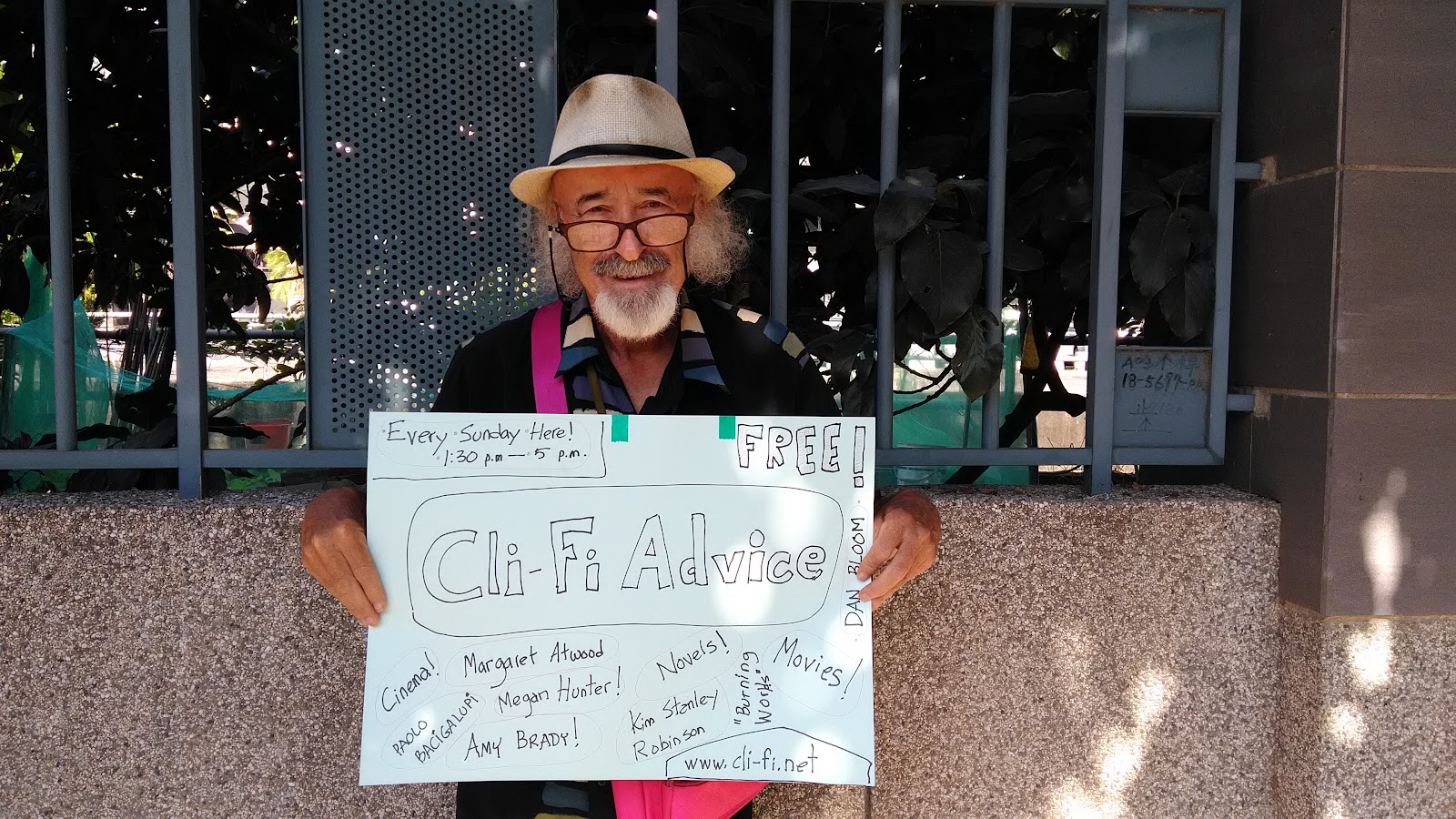
Dan Bloom is a charismatic thought leader who is more active on Twitter than most people half his age. In 2011, he coined the phrase “cli-fi,” now used to describe the publishing world’s trendiest environmental genre. We met online via the Climate Fiction Facebook Group when he found out about an English lesson plan I had created that uses cli-fi to help students learn about book publishing genres. I wanted to know more about Dan’s interesting backstory. Find out how and why he coined the name for this up-and-coming book genre.
Can you tell me about yourself and how you became interested in cli-fi?
In college at Tufts in the 1960s, I was a literature major and had my eyes set on becoming either a novelist or a newspaper reporter. I never wrote that novel, and instead started working for newspapers in New York and Washington DC in the 1970s as a copy editor, proofreader, and cartoonist. In 1979, tired of the rat race on the East Coast, I flew to Alaska and started working for newspapers there. In the 1980s, I was the editor of a weekly paper in Juneau, Alaska called "The Capital City Weekly," which was a free give-away classified ads community paper, and I named it that name from its earlier name of "The Juneau Nickel.'' When I was hired, I suggested a new name and they used my idea to call it the Capital City Weekly. I also lived in Nome, Alaska for two winters and then in 1991 I moved to Tokyo to take a job with an English language expat newspaper there for 5 years. I was again a page editor, a proofreader, a headline writer and a page designer. Then I moved to Taiwan in 1996 and worked for an English language expat paper there in the 2000s.
It was during my work in newspapers that I learned how PR works and how a good eye-catching press release can work wonders. I coined the cli-fi term in 2011 while doing a PR campaign for an American writer in Texas who had written a cli-fi novel titled "Polar City Red." When I was doing the press releases for his book, I used the term "cli-fi thriller" for his novel set in Alaska in a domed city in the near future of 2075. The media in the USA picked up on the ''cli-fi thriller'' phrase and slowly the genre term of cli-fi got used in headlines in NPR, the New York Times, and The Guardian in the UK. I first became interested in the cli-fi term purely as a PR tool for book marketing.
I wanted a new genre as a wake-up call, a warning flare, a PR tool.
Since 2011, I've been blogging about cli-fi at my main website The Cli-Fi Report and contacting academics and journalists around the world, Turkey too, about cli-fi books from my home in Taiwan. The Cli-Fi Report is a research tool to help academics and media folks find cli-fi books.
How would you define the genre cli-fi?
For years, since the 1970s, authors have been writing novels with climate themes. But there was never a term for them. Since 2011, authors in the 21st century have been writing ''climate change fiction,'' or what I dubbed as “cli-fi,” a genre of literature that imagines the past, present, or future effects of climate change. Their work crosses literary boundaries in terms of style and content, landing on shelves marked “sci-fi” and “literary fiction.” There's Margaret Atwood’s Oryx and Crake or Kim Stanley Robinson’s Forty Signs of Rain. There’s Ian McEwan’s Solar and J. G. Ballard’s 1965 novel The Burning World. Each of these novels, like others in the genre, help us to “see” possible futures lived out on a burning, drowning, or dying planet. But at the same time, there are also many cli-fi novels which are not dystopian stories but utopian optimistic stories with positive endings full of hope and promise.
Are there any books that you think almost fit, but not quite? How would you describe these gray ares for the genre?
Good question. There is no cli-fi Canon and there is no one way to write a cli-fi novel and every writer will use their own imagination to create their own kind of cli-fi storytelling. There is no one way to do it. And I am open to all points of view on this and to all styles.
What are some classic cli-fi novels or authors that would be good starting points for readers who are new to this trend? I recommend two good ones as starting points: Barbara Kingsolver's 'FLIGHT BEHAVIOR' and Nathaniel Rich's Odds Against Tomorrow.
How has the genre evolved over time?
It has evolved since 2013 when NPR did a major segment on the radio network about the rise of cli-fi, where the radio producer Angela Evancie interviewed both Kingsolver and Rich for the broadcast. It aired on April 20, 2013 and the genre took off from there after the NPR story went viral, with follow up news articles in the New York Times in 2014, and The Guardian in 2015. Since then articles and reviews appeared in the BBC website, Slate, Salon, Grist, Treehugger and the Financial Times in London.
The genre continues to evolve as literary critics chime in with their own views of what cli-fi is and should be or could me. Me, I am just a cheerleader for the genre and for its practitioners, the writers. I am all ears. I have no agenda, just to read and listen to all points of view. I suspect that the next 80 years, from 2020 to 2100 will be pivotal for the evolution of the genre. I wish I could be alive to see which way it will go, but I will be dead in ten years.
Also, since your post will appear in Turkey, Mustafa Akkus who tweets at @m_makkus is interested in cli-fi there. He tweeted about the genre last year in Turkish: ''Küresel iklim değişimi ile beraber Science-fiction (sci-fi)roman ve filmlerinin yerini Climate-fiction(cli-fi) roman ve filimler almaya başlada. İklim değişiminin edebiyet ve sinema sektörüne etkisi.'' It was the headline of a newspaper article in Turkey. So there is interest there, too, among academics, literary critics, and climate activists.
Do you think the golden age of cli-fi is upon us? Why or why not?
Yes, these are the early days, now, of the Age of Cli-Fi. Beginning in 2012, when Polar City Red became the first novel to be marketed specifically as a cli-fi novel, I feel the Gold Age of Cli-Fi will really bloom in the 2050s and into the 2090s. We are just at the beginning stages now and it is exciting to watch.
How have you promoted the genre?
I am a born promoter. I am not a novelist at all. But I love PR from my days working at newspapers in Alaska and Japan, and while I never studied PR, I learned about how it works just by keeping up with current news in the publishing industry, mostly by reading the book trade magazine titled Publishers Weekly, or PW. That magazine has been and still is my Bible for book PR. I just followed strategies that seemed successful.
I've used Twitter and Facebook to promote the genre online. In the last 8 years I have written and mailed over 500 press releases to editors of magazines and newspapers around the world. That's my modus operandi, my M.O. I also started a Facebook group page for cli-fi with over 500 members from academia and the writing community worldwide, including several academics from Turkey, among them Serpil Oppermann.
And it's not just me involved in the promotion of cli-fi. Scott Thill, a writer in Los Angeles is the world's most prolific promoter and user of the #CliFi hashtag for environmental destruction news items and fossil fuel destructiveness and man made global warming issues. Everyday, almost every day, 24/7, Scott, a resident of Los Angeles and a graduate of Berkeley (as a grad student in the 1990s) and a longtime writer for Wired magazine and the Huffington Post, among other sites, tweets via @morphizm and many of his tweets use the #CliFi hashtag, created originally by PR consultant Lisa Devaney in the UK as a PR tool for the cli-fi community worldwide.
Do you think more authors will start to market their novels as cli-fi?
For sure. Every week, I get emails and Twitter messages and Facebook messages from new writers telling me that they are beginning to write a cli-fi novel and they ask me for advice on finding an agent, finding a publisher, marketing, PR and book tours. I tell them what I know. So I see a huge future of cli-fi authors over the next 80 years and well into the 22nd century. I have no doubt that this genre is going keep growing and growing.
Is there any definitive list available for people to use as a cli-fi reading guide?
There are no official cli-fi reading lists, but Goodreads has a list of 200 cli-fi novels and Amazon now has over 100 cli-fi novels listed. But since there is no cli-fi canon, there is no definitive list.
What is your all time favorite cli-fi book?
You know, my favorite cli-fi novel of all time is not a cli-fi novel at all but it ties in with my work as a cli-fi theorist and promoter. It's that 1957 novel by Nevil Shute titled On the Beach, which was a pulp fiction dime novel paperback from Australia about nuclear war and nuclear winter, and which had a huge impact on world leaders in the 1960s and 1970s. So I am looking for, and hoping for, the On the Beach style of a cli-fi novel about climate change. Who will write it and when? I stay awake at night thinking about this sometimes.
What would it mean for the world if we stopped flying? A good question for the Anthrocene generation as we head toward "a flying finish"

What would it mean for the world if we stopped flying?
It's easier and cheaper than ever to fly across the world, but this is coming at an incredible cost to the global warming impacts of our planet. As a result, an increasing number of people around the world are beginning to think about flying less and taking business trips or vacations in the future by train.
So the mantra for 2019 is ''Cut down on your plane trips!'' One of the most famous activists for this new movement is the 16-year-old Swedish climate speaker Greta Thunberg, who recently attended the Davos World Economic Forum in Switzerland with her father, with the two of them travelling overnight by train from Stockholm's main station to Davos, a journey of 24 hours one way. And they returned two days later the same way -- by train. Greta has trained her mom and dad to stop flying and often tweets about it.
There are even two popular hashtags now on Twitter to call attention and follow this growing movement: #FlyLess and #NoFly
Here's the motto for 2019: Travel is still possible without flying! Even taking one less flight will help drastically reduce your carbon footprint.
Find out more here.
http://brewtopia.co/actions/reduce-personal-air-travel-emissions/
In Holland, some universities are also following this worldwide trend.
While some of the academic staff at Radboud University in Holland fly regularly to Paris or London, this is beginning change as the university is making plans to reduce the amount of air travel by staff. While precise figures on the number of flights are not yet available, it is already clear that academic staff fly frequently to Berlin, Hamburg, Paris, London and Munich, cities that can be reached by train in eight hours or less.
'‘We want to start a dialogue about whether we really need to fly to these cities,’' according to Green Office coordinator Thijmen Sietsma. '‘This item is on the agenda at many universities. Leiden and Utrecht, for example, are currently making an inventory of their air travel. I hope that people will think twice before boarding a plane.’'
Sietsma is quick to point out that the idea is not to ban all air travel from now on. ‘'International contacts, of course, are very important for academics but this is at odds with our university’s wish to reduce its environmental footprint. We want to tackle the issue in the right way.''
He says his main concern is to raise awareness about air travel.
''Flying has a massive impact on the environment,’' he explains. '‘It’s something that you as an individual can fairly easily influence. I hope that people will think twice before boarding a plane. They should ask: Do I really have to attend that conference in South America or could I go to a conference closer to home instead?'’
According to climate scientists, there is a reason for this kind of activist movement.
"The IPCC has estimated that aviation is responsible for around 3.5 percent of all anthropogenic climate change. Aviation's contribution could grow to 5 percent of the total contribution by the year 2050 if action is not taken to tackle these emissions, although the highest scenario is 15 percent," sources say.
On Twitter, Emma Richey says: ''Due to the immense pollution caused by airplanes, I'm going to (at least try) restrict myself to no more than 1 flight per year. Let's #flyless and travel by bus or train instead!"
So yes, the environmental impact of flying is a huge blind spot for many people around the world. How about you?
On the BBC website, a news article discusses the two Swedish mothers who want people to give up flying for a year.
Find out why here. https://www.bbc.com/news/video_and_audio/headlines/46362159/the-two-swedish-mums-who-want-people-to-give-up-flying-for-a-year
So far the Swedish moms have persuaded 10,000 people to commit to not taking any flights in 2019.
Their social media initiative, ''No-fly 2019,'' is aiming for 100,000 pledges, and has been asking participants to post their reasons for signing up.
The two women, Maja Rosen and her neighbor Lotta Hammar, say they started the campaign to show politicians in Sweden and other nations what needs to be done to try to halt climate change.
How harmful are you flying habits?
A BBC reporter writes: ''Planes run on fossil fuels, and we haven’t figured out a scaleable alternative. Although some early efforts to use solar panels to fly around the world have had success, we are still decades away from commercial flights running on solar energy. A normal transatlantic round-trip flight can release around 1.6 tons of CO2 -- almost as much as the average yearly emissions of one person in India. This also highlights the inequality of climate change: while everyone will be affected, only a minority of humans fly and even fewer people take planes often.''
So now there are groups of scientists and members of the public who have decided to give up flying or who fly less. Virtual meetings, holidaying in local destinations or using trains instead of planes all are ways to cut down.
For Peter Kalmus, an American atmospheric scientist at NASA's Jet Propulsion Laboratory and the author of
''Being the Change: Live Well and Spark a Climate Revolution,'' there's a plan, which he outlines in an article in the Guardian in London.
Kalmus says: "I haven’t flown since 2012, nor have I wanted to.''
His explanation: ''Few people know how harmful it is to fly in planes, including scientists. In 2010, I sat down and estimated my climate emissions. It turns out that, hour for hour, there’s no better way to warm the planet than to fly. I’d flown 50,000 miles during the year, mostly to scientific meetings. Those flights accounted for 3/4 of my annual emissions. Over the next two years, I gradually decreased my flying.''
''Eventually, there came a day when I was on the runway about to take off and felt an overwhelming desire not to be on the plane. I saw too clearly the harm it was doing to the world’s children, to all the beings on our planet. I haven’t flown since 2012, nor have I wanted to.''
Climate activists tend to fly a lot. This sends its own contradictory message, Kalmus says.
On Twitter, Kalmus tweets: ''Reason for #FlyingLess: to raise awareness and shift the culture. It's an emotive action, it gets attention. Also, I don't want to fly anymore, knowing what I know. I don't do it for the market signal or for the direct emissions reduction. I don't think those are significant.''
So imagine what would happen if prominent climate activists like Bill McKibben and Andy Revkin and Katharine Hayhoe and outspoken celebrities and Hollywood movie stars would consciously, publicly, and radically reduce their own fossil fuel use. They could begin by flying less.They could follow Greta Thunberg's example. Hey Leonardo, how about it? Al Gore, how about it? Arnold Schwarzeneggar, how about it?
''Yeah. One can become world famous like Greta Thunberg without flying in six months," says Aarne Grunland on Twitter in Helsinki.
What would it mean for the world if we stopped flying? https://www.bbc.co.uk/sounds/play/p06xgkz0
It's time for American journalists to write about the Flying Less hashtag and follow the example of British and Finnish journalists as they lead a meme to a flying finish.
Subscribe to:
Posts (Atom)